On this page
Adjectives for a resume come in two varieties: ones the algorithm scores, and ones it ignores completely. Most job seekers fill their resumes with the second kind — "motivated," "passionate," "detail-oriented" — and wonder why they're not getting callbacks.
The short answer: ATS systems don't score personality words. They score hard-skill terms, tool names, certifications, and job-specific descriptors pulled directly from the job description. If your adjectives aren't in the posting, they're invisible to the parser.
Here's what actually scores, what to cut, and how to find the right words for the specific role you're targeting.

Why Most Adjectives Fail the ATS
An applicant tracking system doesn't read your resume the way a human does. It parses structured fields — job titles, dates, skills — and runs keyword-match scoring against the job description. Words like "hardworking" and "results-driven" aren't in any job description. They're filler you've added, and the algorithm treats them as noise.
In our testing across Greenhouse, Lever, Workday, Taleo, and iCIMS, soft-skill adjectives in a skills section score exactly zero on every platform. The algorithm learned to ignore them because every resume has them. (It's the resume equivalent of listing "breathes air" as a qualification.)
What ATS systems do score: exact-match terms from the job description, technical tool names, and skill-specific descriptors. A job posting that says "proficient in Python" wants the phrase "proficient in Python" — not "experienced with programming languages" and not "strong technical skills."
This is the core problem with most resume adjective advice on the internet: it's written for human readers. ATS scoring runs before a human ever sees your resume. According to Jobscan research, 98% of Fortune 500 companies use an ATS to screen candidates — meaning your adjective choices need to pass the algorithm first.

Adjectives That Actually Score
The adjectives that move your ATS score are the ones attached to specific skills, tools, or measurable outcomes. They describe competency level, not personality. Here's the distinction:
- Scores: "proficient in SQL" — matches the exact phrase from the job description
- Doesn't score: "strong analytical abilities" — generic, not parseable as a skill
- Scores: "certified in AWS" — maps to a credential field
- Doesn't score: "passionate about technology" — adjective with no matching keyword
The adjectives that work are competency modifiers: proficient, certified, experienced, licensed, fluent, advanced, senior-level, junior-level, trained in. They tell the parser your relationship to a specific hard skill it can match against the job description.
These work because they attach to nouns the ATS is already looking for. "Proficient" alone scores nothing. "Proficient in Salesforce" scores well when the job description includes "Salesforce experience required."
Hard-Skill Adjectives by Field
The right modifiers vary by industry. Here's what actually appears in job descriptions — and therefore what scores:
Technology: proficient, senior, full-stack, backend, frontend, cloud-certified, DevOps-trained, agile, scrum-certified
Finance: CFA-certified, licensed, GAAP-compliant, forensic, quantitative, regulatory-focused, SEC-registered
Marketing: data-driven, SEO-optimized, paid-media, conversion-focused, brand-aligned, HubSpot-certified
Healthcare: licensed, board-certified, HIPAA-compliant, bilingual, trauma-trained, patient-facing
Project management: PMP-certified, agile, cross-functional, stakeholder-facing, budget-accountable, PMO-led
Notice the pattern: these adjectives either name a certification, describe a methodology, or specify a working context. They're searchable. Generic personality adjectives are not.

Adjectives to Cut Immediately
A Jobscan analysis of over one million resumes found that the most overused resume words are almost entirely soft-skill adjectives. The algorithm has seen them so many times it assigns them zero weight. More importantly, so have recruiters — a TopResume survey found that 63% of recruiters say vague language actively hurts a resume's impression.
Cut these on sight:
- Motivated / self-motivated
- Passionate / enthusiastic
- Detail-oriented / meticulous
- Results-driven / goal-oriented
- Dynamic / innovative
- Hardworking / dedicated / committed
- Team-player / collaborative
- Proactive / forward-thinking
- Versatile / adaptable
- Creative (without specifics)
Every single one of these is claimed by every single applicant. They've been rendered meaningless by overuse, and the ATS doesn't score them regardless. The space they occupy could hold a keyword that actually moves your score.
The Soft-Skill Trap
Here's the thing about soft skills: they matter. Communication, leadership, collaboration — hiring managers care about these. The mistake is listing them as adjectives in your skills section.
Soft skills in a skills section score nothing. Soft skills proven in your bullet points score everything. There's a difference between "excellent communicator" in your header and "Presented quarterly business review to C-suite; proposal adopted and drove $2.3M in cost savings" in your experience section. One is an adjective. The other is evidence.
The rule: prove soft skills in bullets. List hard skills in your skills section. Adjectives go where they attach to something specific — not floating freely in a summary claiming personality traits you haven't demonstrated.
Free ATS Score Check
Your result looks like this —
get yours in 30 seconds.
Drag & drop your resume here
PDF or Word · max 10 MB
Results in under 30 seconds · no sign-up required

Where to Place Adjectives on a Resume
Placement matters almost as much as word choice. ATS systems weight certain sections more heavily than others.
Skills section: Use hard-skill modifiers only. "Proficient in Python, advanced SQL, certified in AWS Solutions Architect." The skills section is parsed as structured data — it's scored twice, once as a dedicated field and once in full-text search. Don't dilute it with personality adjectives.
Professional summary: This is where your best keyword-backed adjectives live. Lead with your competency level ("Senior data engineer with 8 years of...") then follow with specific tools and certifications. Keep the summary under 100 words. The summary is often the first field parsed — make every word count.
Experience bullets: Use action verbs rather than adjectives. "Led," "built," "reduced," "increased" — these carry more weight than "successfully managed" or "effectively coordinated." If you do use adjectives here, attach them to specifics: "cross-functional team of 12," not "diverse team."
ATSFixer data shows resumes with a focused skills section score an average of 10–15 points higher on ATS screening than equivalent resumes that bury keywords inside vague summary copy. The structure matters as much as the words.
How to Find the Right Adjectives for Any Job
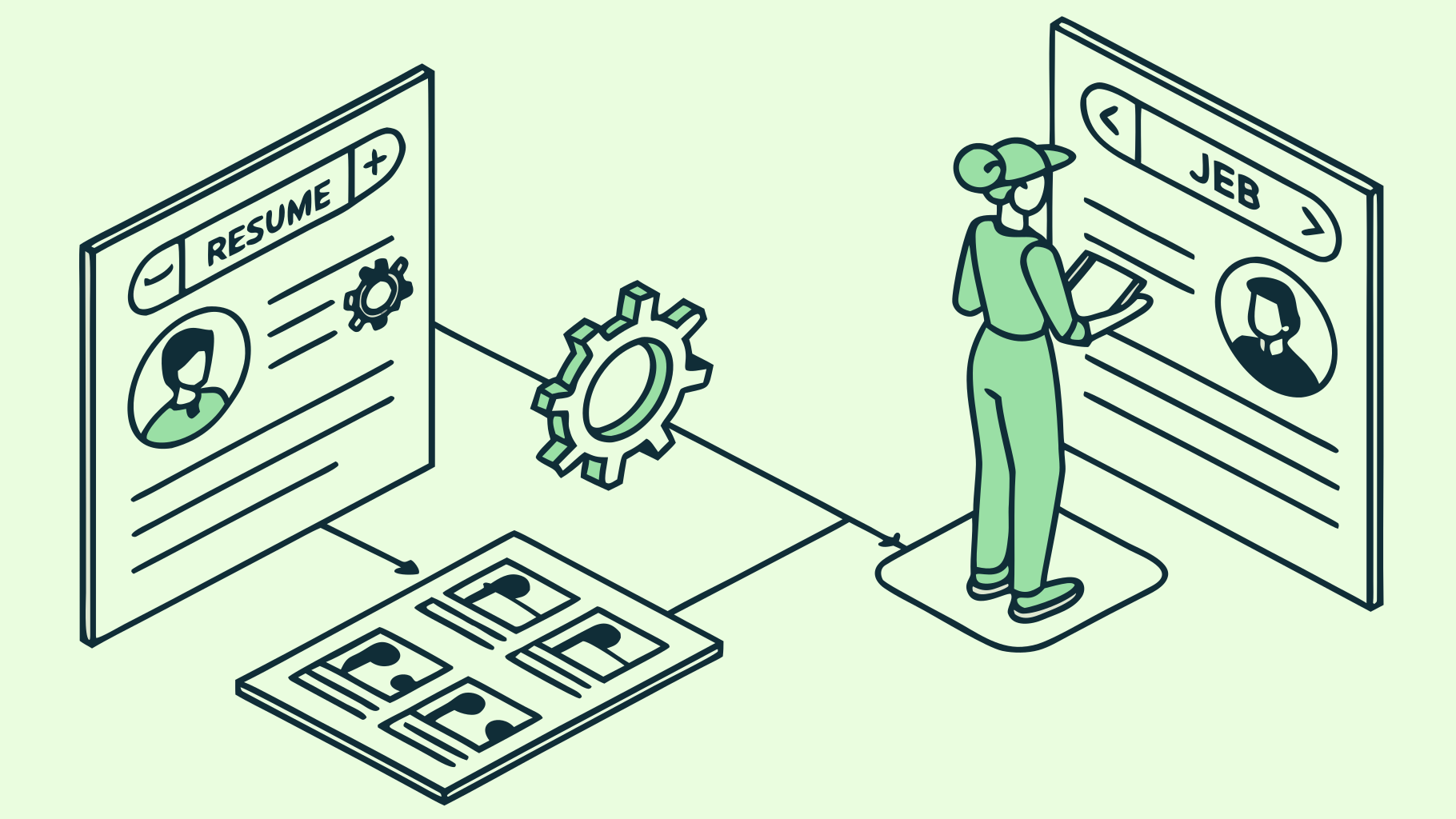
The job description is your answer key. Everything you need is already written down by the person who will screen your application. Your job is to mirror it — not paraphrase it, not synonym it. Mirror it exactly.
Here's the process:
- Paste the job description into a text document
- Highlight every adjective and modifier attached to a skill or requirement
- Note the exact phrasing — "experienced with," "proficient in," "strong background in," "certified in"
- If those phrases apply to you, use that exact phrasing on your resume
- If they partially apply, use the closest honest version ("working knowledge of" rather than "proficient in" if you're still developing the skill)
The "synonyms don't count" lesson is one of the most important things to understand about ATS scoring. A project manager whose resume said "cross-functional collaboration" instead of "stakeholder communication" — the exact phrase in the job description — scored zero for that requirement. Same skill. Different words. The algorithm found zero matches. She changed two phrases, got the interview, got the job.
That's what the right adjective — the exact one from the job description — actually does to your score.
You can automate this process. ATSFixer compares your resume against any job description and flags exactly which terms you're missing or using with the wrong phrasing. It takes about 30 seconds and gives you the exact-match keywords the algorithm is scoring — including the modifier adjectives attached to each required skill. Paste it in, see your score, fix the gaps.
Job seekers who tailor their resume to each application are 3× more likely to get an interview, according to Jobscan's analysis of over one million resume scans. Tailoring isn't rewriting your entire document — it's swapping the adjectives and skill modifiers to match the posting's exact language.

When Adjectives Don't Matter
Honestly: if you're applying to a company with fewer than 50 employees, the ATS argument mostly doesn't apply. Smaller companies often read resumes directly. In that context, clear, specific language matters more than keyword density, and a well-chosen adjective in a summary can actually help.
The same applies to roles filled through referrals. If a hiring manager already knows your name, your resume is context — not a filter to pass. A human is reading it, so human-readable language matters more than parse-friendly structure.
For everything else — Fortune 500 applications, job board submissions, any company using Greenhouse, Lever, Workday, Taleo, or iCIMS — the algorithm is reading your resume before any human does. In those contexts, the adjective that matters is the one in the job description, not the one you chose to describe your personality.
If you're unsure which category your target company falls into, assume ATS. 98% of large employers use one. Optimising for the algorithm doesn't hurt your human readability — it just means replacing "passionate self-starter" with "proficient in Salesforce CRM." Which, if you think about it, is the better sentence anyway.
You made it to the end of an article about resume word choices. You have more patience than the average ATS. That already puts you ahead of the people still writing "results-driven professional" in their summary.
Related from ATSFixer
Frequently Asked Questions
The best adjectives for a resume are competency modifiers attached to specific skills: "proficient in Python," "certified in AWS," "fluent in Spanish," "licensed in California." These score well on ATS because they match exact phrases in job descriptions. Generic personality adjectives like "motivated" or "detail-oriented" score zero on every major ATS platform.

Jordan Marcus
Senior Career Strategist
Jordan has reviewed 4,000+ resumes and coached candidates into roles at Google, Stripe, and McKinsey. She writes about the mechanics of ATS and what actually gets people interviews.