On this page
- Why Most Resume Tips Miss the Point
- 11 Resume Improvement Tips That Actually Work
- 1. Switch to a Single-Column Layout
- 2. Submit a Text-Based PDF (Not an Image)
- 3. Mirror the Exact Keywords From the Job Description
- 4. Add a Dedicated Skills Section
- 5. Rewrite Your Summary With Job-Specific Keywords
- 6. Quantify Every Achievement You Can
- 7. Remove Everything That Doesn't Match the Role
- 8. Check Your Dates and Employment History
- 9. Name Any Employment Gap
- 10. Run It Through an ATS Checker
- 11. Tailor It — Every Single Time
- What Improving Your Resume Won't Fix
- If You Only Have 30 Minutes
- Frequently Asked Questions
Most resume improvement tips are aimed at the wrong reader. They tell you to use stronger action verbs, quantify your achievements, and proofread carefully. Good advice — for the human who eventually reads your resume. The problem is getting there.
75% of resumes are rejected by an ATS before a human ever sees them. So if your improvements don't address the algorithm first, you're polishing something that's getting filtered out anyway.
These 11 resume improvement tips are ordered by impact. The first several are about passing the ATS. The later ones are about making the recruiter want to call. Both matter — but in that order.
Why Most Resume Tips Miss the Point
There are two readers for your resume: the algorithm and the human. Most tips only address the second one.
The algorithm doesn't care about your summary's narrative arc. It cares whether "project management" appears exactly as written in the job description — not "project oversight," not "leading cross-functional initiatives." Exact match. Full stop.
A 2021 Harvard Business School study of 8 million job postings found that 88% of executives acknowledge their ATS filters out qualified candidates. The executives know. They haven't changed it, because the alternative — reading 250 applications manually — isn't operationally viable. The filter exists by design.
Your job is to pass it. Then impress the human. In that order.

11 Resume Improvement Tips That Actually Work
These are ranked by how much they move your ATS score. Tackle them top to bottom if you can. If you're short on time, skip to the prioritisation section at the bottom.
1. Switch to a Single-Column Layout
This is the highest-impact change you can make. ATS parsers read documents left-to-right, line by line. A two-column layout — skills on the left, experience on the right — gets parsed as one horizontal strip of garbled text. Your job titles merge with your skill names. Your dates disappear. To the algorithm, you look like a blank page.
In ATSFixer's internal testing, a software engineer with eight years of experience submitted a beautifully designed two-column resume that scored 12/100. He converted to a single-column format with identical content. His score jumped to 71/100. Interview request that week.
If your current resume has columns, that's the first thing to fix. Everything else is secondary.
One more thing to strip out: text boxes, tables, graphics, icons, and sidebars. Taleo and older iCIMS installs — still in wide use at banks, healthcare, and government — can't parse any of those. A clean, single-column document with standard section headings covers every major ATS platform.
2. Submit a Text-Based PDF (Not an Image)
If you can't select and highlight the text in your resume PDF with your cursor, neither can the ATS parser. Image-based PDFs — scans, screenshots, PDFs exported from Canva with embedded graphics — score zero on every platform. The parser sees a picture of words, not words.
Export your resume from a word processor (Word, Google Docs) as a PDF. Open it. Click on the text. If you can select it, you're fine. If you can't, start over with a text-based document.
(Yes, some beautifully designed Canva resumes fall into this trap. The algorithm is unsympathetic to good design.)
3. Mirror the Exact Keywords From the Job Description
ATS platforms do exact-match keyword scoring on most fields. Synonyms — even perfect ones — score zero.
A project manager applied for a role that listed "stakeholder communication" as a required skill. Her resume said "cross-functional collaboration." Same meaning. Zero match. The system scored her accordingly and she was filtered before the recruiter saw her name. She changed two phrases. Got the interview. Got the job.
The fix: read the job description line by line. Pull out every skill, tool, and phrase they've used. Check whether your resume uses those exact words. If you wrote "managed vendor relationships" and the job says "supplier management," change it.
A job description typically contains 15–25 hard-skill terms, according to Jobscan's analysis of over 1 million resume scans. You don't need to hit every one — but the closer you get, the higher your score.
See our full breakdown of how to find and place resume keywords for a step-by-step approach.
4. Add a Dedicated Skills Section
The skills section is the most under-used part of a resume. It's also where ATS parsers specifically look for structured keyword data. Keywords here score twice: once as a dedicated field, once in the full-text search pass.
Most people either skip the section entirely or fill it with "team player" and "detail-oriented" — which is the resume equivalent of showing up to a job interview and describing yourself as "a person who breathes." Technically accurate. Useless to the system.
What goes in the skills section: hard skills only. Software tools, methodologies, certifications, programming languages, industry-specific terms. Resumes with a dedicated skills section score an average of 10–15 points higher on ATS screening than equivalent resumes without one, based on ATSFixer's internal data.
Read more on what skills to include and how to list them.
5. Rewrite Your Summary With Job-Specific Keywords
A generic professional summary — "Results-driven professional with 8 years of experience seeking a challenging role" — is wasted space. It's also a wasted keyword placement. The summary field is read early in the parse. Keywords here carry weight.
Rewrite your summary for each application. Pull the top 3–4 keywords from the job description and weave them in naturally. Keep it to 3–4 sentences. Write it as a statement of what you do and what you bring, not as a wish list for what you want. For worked examples across different career stages, the guide on resume introduction examples shows the exact structure and what each type of intro does to your ATS score.
Before: "Experienced marketing professional with a passion for driving results."
After: "Digital marketing manager with 6 years in B2B SaaS, specializing in demand generation, marketing automation (HubSpot, Marketo), and pipeline reporting."
The second one passes an ATS scan for a demand gen role. The first one doesn't pass anything.
6. Quantify Every Achievement You Can
This one is for the human reader. Numbers compress a lot of meaning into small space, and recruiters spend an average of 7.4 seconds on an initial resume scan (Ladders eye-tracking study, 2018). Numbers stop the eye.
"Managed a marketing team" tells a recruiter nothing about scale. "Managed a 6-person marketing team, grew inbound leads from 800 to 2,400/month in 18 months" tells them a lot — and uses keywords like "inbound leads" that might be in the job description.
If you can't remember exact numbers, use ranges. "Cut onboarding time by roughly 30%" is better than "improved onboarding process." If you genuinely have no numbers, describe impact: "Sole developer on a tool now used by 4 internal teams." That's still more specific than "built internal tools."
7. Remove Everything That Doesn't Match the Role
One page is not a rule. Compressing 12 years of experience onto one page to follow a myth costs you keywords, context, and proof. Two pages is fine. Three is usually too many. The full breakdown — by career stage and industry — is in the guide on how many pages a resume should be.
The real rule: if it doesn't appear in the job description and doesn't demonstrate a skill that does, cut it. A summer job you held 15 years ago, an unrelated certification, a skills section full of software you haven't used in years — none of this helps your score and all of it dilutes the signal.
63% of recruiters say they reject resumes for formatting issues, not content (TopResume, 2022). Irrelevant content is a formatting issue. It makes the recruiter work harder to find what's relevant. They won't.
8. Check Your Dates and Employment History
ATS parsers use dates to verify employment timeline, calculate tenure, and flag gaps. Missing months, inconsistent year formatting, or end dates listed before start dates can corrupt the parse entirely.
Use a consistent date format across every entry: "Jan 2020 – Mar 2023" or "01/2020 – 03/2023" — pick one and stick to it. Don't mix "2020–Present" with "January 2019 to December 2021." Parsers are literal.
Also check: are your jobs in reverse chronological order? Most ATS platforms expect current-to-oldest. If yours isn't, the parser may invert your experience level.
9. Name Any Employment Gap
The gap that destroys applications is the unexplained one. The ATS flags blank timeline space, and the recruiter assumes the worst — because there's nothing else to assume.
If you have a gap, name it. "Career Break — Family Caregiving, 2023–2024." "Professional Development, 2022–2023." "Freelance Consulting, 2021–2022." Date it. One line. Move on.
A candidate with an 11-month gap — a year caring for a sick parent — listed it exactly that way, then spent two sentences in her cover letter on it. Not a problem at any of the four companies that interviewed her. One hiring manager told her directly: "We care that you explained it. We don't care that it happened."
10. Run It Through an ATS Checker
You can't see your own ATS score from the outside. You submit, you wait, you hear nothing. An ATS checker shows you the score before you submit — what keywords you're missing, what the parser actually extracted, and where your formatting caused problems.
ATSFixer scores your resume against a specific job description within 30 seconds, shows exactly which keywords are missing, and rewrites the tailored version if you want one. Our scoring is within ±3 points of real ATS output across Greenhouse, Lever, Workday, Taleo, and iCIMS — which we test against every week.
For a broader look at how AI-based resume tools compare, see our breakdown of the best AI resume checkers.
If you're curious how the underlying system works, our guide on how ATS systems work covers the mechanics from the recruiter's side.
11. Tailor It — Every Single Time
Honestly, this is the one most people skip — and the one that matters most. Job seekers who tailor their resume to each application are 3× more likely to get an interview, based on Jobscan's analysis of over 1 million resume scans.
That's not a marginal difference. That's the difference between the algorithm surfacing your resume and not. "Just apply to more jobs" is bad advice if the underlying document isn't passing ATS. Ten tailored applications outperform fifty generic ones.
Tailoring doesn't mean rewriting from scratch each time. It means: update the summary, update the skills section, update the top 3–4 bullet points in your most recent role to reflect the job description's language. That's it. The bones stay the same. The vocabulary changes.
ATSFixer does this in 30 seconds — paste your resume and the job description, and get a fully tailored version with the exact keywords matched.
Free ATS Score Check
Your result looks like this —
get yours in 30 seconds.
Drag & drop your resume here
PDF or Word · max 10 MB
Results in under 30 seconds · no sign-up required
What Improving Your Resume Won't Fix
These tips won't help you if the fundamental problem isn't your resume.
If you're applying to companies under 50 people, most of them don't use an ATS at all — a human is reading your resume directly. In that case, formatting clarity and writing quality matter more than keyword density. Don't keyword-stuff a document that's going to a founder who has to read it over coffee.
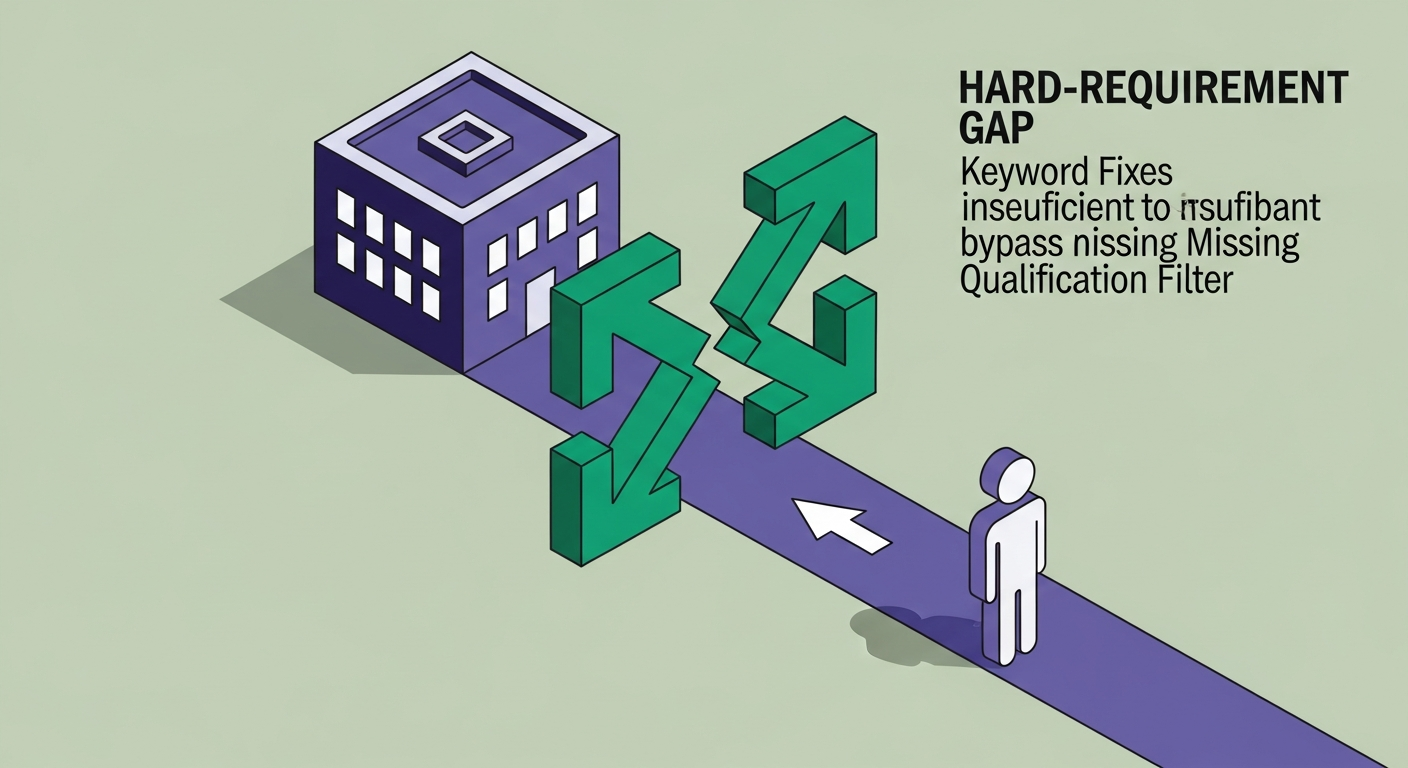
If the role requires a qualification you don't have, resume optimisation won't manufacture it. An ATS checker will tell you your score is high and you'll still get filtered — because the hard filter isn't keyword-based, it's requirement-based. A job that requires a licensed CPA won't call you without the license, regardless of how well your resume scans.
And if you're applying to roles significantly above your experience level, no formatting fix covers the gap. A resume improvement is a signal optimisation. It can't change the underlying signal.
If You Only Have 30 Minutes
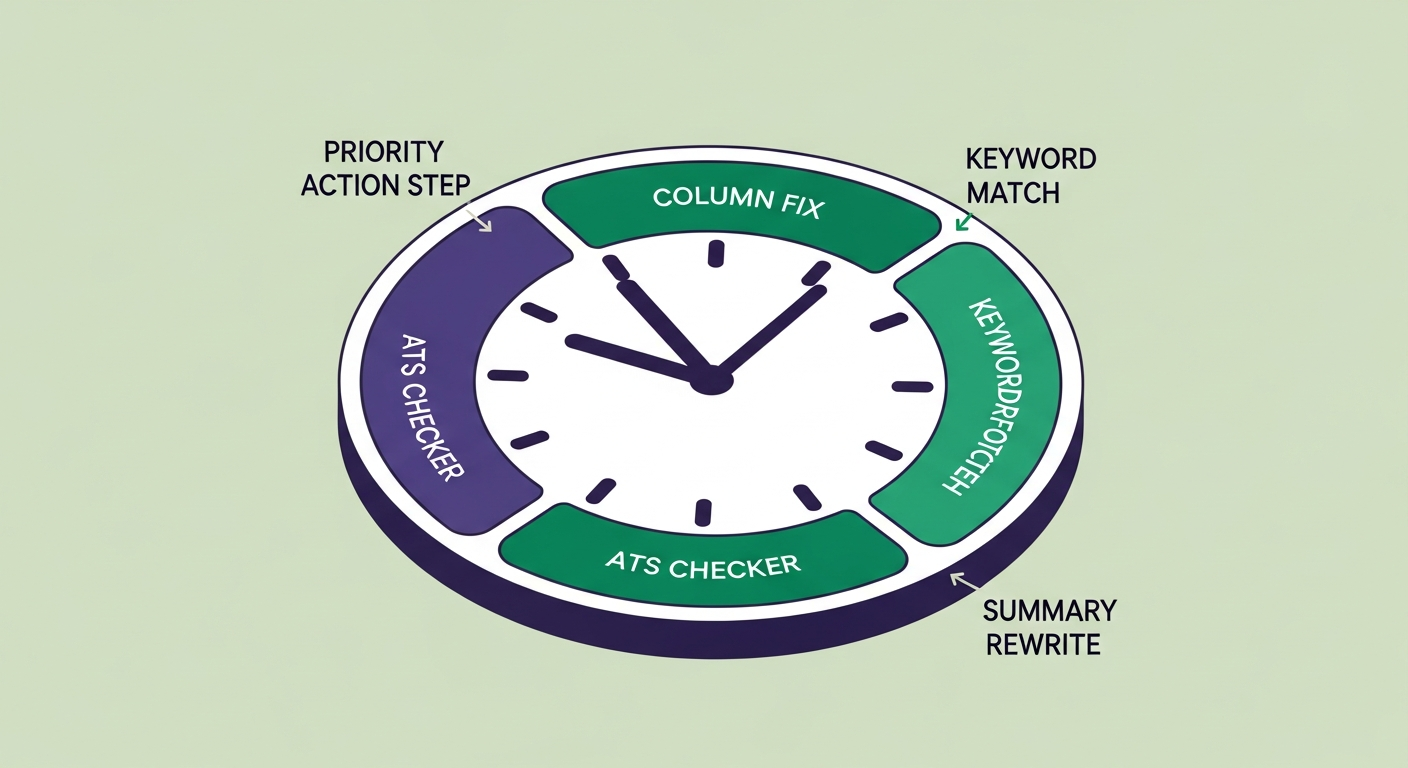
Do these four things, in this order:
- Convert to single-column if yours has columns. This is a formatting emergency.
- Add the exact keywords from the job description to your skills section. Paste them in, verify you're using the same phrasing.
- Rewrite your summary for this specific role. Three sentences, with the top 2–3 keywords from the posting.
- Run it through an ATS checker. See the score. Fix the gaps the tool surfaces.
That's a meaningful improvement in 30 minutes. The rest of the list matters, but those four will move your score more than anything else.
You made it to the end of a 2,500-word article about resume formatting. You have more patience than the average ATS. That already puts you ahead.
Frequently Asked Questions
Related from ATSFixer
Frequently Asked Questions
Switching to a single-column layout has the biggest single impact on ATS scores. Two-column and sidebar designs cause parsers to merge your skills with your job titles into garbled text, often scoring near zero. After fixing your layout, keyword matching is the next highest-impact change.

Mina N.
Career Coach & Resume Strategist
Mina holds a Master's in Organisational Psychology and has coached over 600 mid-career professionals through layoffs, pivots, and promotions. She focuses on the intersection of self-presentation and the systems that evaluate it — because sounding good on paper is only half the battle.