On this page
- What Goes in a Resume Work History Section
- How ATS Systems Parse Your Work History
- The Date Formats That Break ATS Parsers
- How Far Back Your Work History Should Go
- Bullet Points That Pass ATS and Impress Recruiters
- How to Handle Employment Gaps in Your Work History
- Special Cases: Multiple Jobs, Freelance, and Short Stints
- When These Rules Don't Apply
The work history section is the heaviest section on your resume. Not by word count — by ATS weight. It's where the algorithm calculates your years of experience, extracts employer names, and decides whether your job titles match what the company is hiring for.
Most people treat it like a list of things they did. It's actually a structured data field that an automated system parses before any human sees your name. The ATS isn't reading your bullets for meaning. It's scanning for a specific sequence of fields — title, employer, dates, bullets — and extracting what it can find in that order.
If the structure is wrong — wrong date format, wrong field order, buried job titles, or a two-column layout that merges your sidebar with your employment history — your experience looks shorter than it is. Or it doesn't appear at all.

What Goes in a Resume Work History Section
Each job entry in your work history section should include five elements, in this order:
- Job title — first, on its own line or prominently at the start
- Company name — on the same line or directly below the job title
- Location — city and state (or "Remote")
- Date range — month and year, start to end
- Bullet points — 3–5 per role describing what you did and what resulted
The ATS cares about every one of them. Job title feeds the title-match scoring. Company name and dates feed the work history verification. Location filters you in or out of on-site roles. Bullets deliver keywords.
The order matters because parsers are trained on the standard layout. Job title first is the standard. If you put the company name first and the title second, some ATS platforms will extract the company name as your job title. That's not a theoretical edge case — it's a documented parsing failure in Greenhouse and Workday that ATSFixer testing catches regularly.
List jobs in reverse chronological order. Most recent first. Always. The algorithm weights recent experience more heavily, and the recruiter's eye goes to the top of the list first. Starting with your 2007 job is optimising for the wrong reader in the wrong year.
How ATS Systems Parse Your Work History
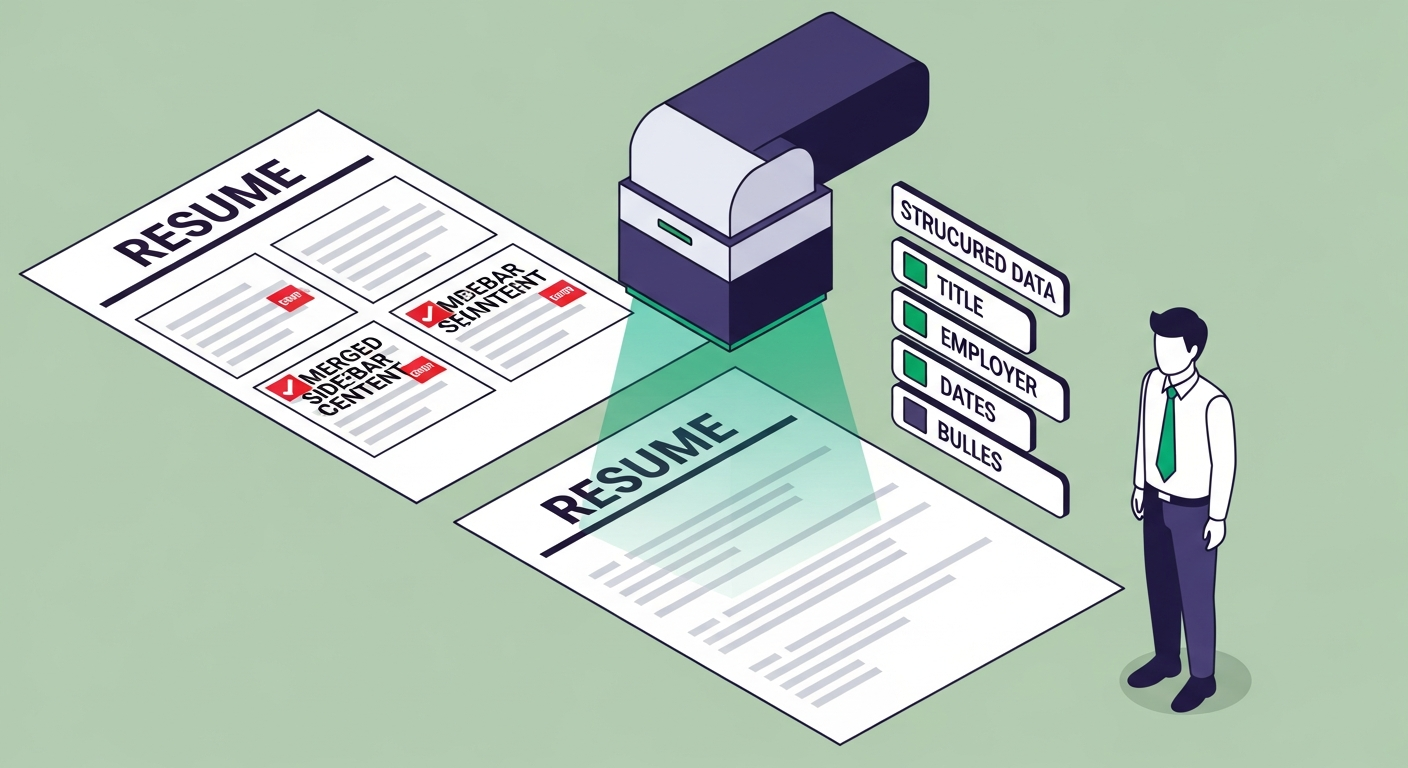
ATS parsers don't read your resume the way a recruiter does. They scan for structural patterns. They're looking for a specific sequence — title, employer, location, dates, bullets — and when they find it, they extract it cleanly into separate database fields.
When they don't find that sequence — because you've put your company name first, or hidden your dates at the end of a line, or used a two-column layout that merges your sidebar with your job history — they either guess, partially extract, or fail silently.
The silent failure is the worst kind. Your experience gets filed as unstructured text, the date parser finds nothing to calculate, and your years-of-experience score drops to zero. You look like a recent graduate with no history. The recruiter never knows. You never know.
A software engineer with 8 years of experience used a beautifully designed two-column resume — skills on the left sidebar, experience on the right. His ATS score: 12/100. The parser read the columns left-to-right in a single pass, merging the skills list with the job titles into garbled text. The system couldn't extract his employer names, titles, or dates. He looked, to the algorithm, like a blank page.
He converted to single-column format. Same content, no changes beyond layout. New score: 71/100. Interview request that week.
ATSFixer internal testing shows 1 in 3 resumes submitted through Workday are corrupted during parsing due to columns, tables, or text boxes. The most common source of corruption is a sidebar that contains anything other than decorative whitespace.
The Date Formats That Break ATS Parsers
Date parsing failures are the most underreported cause of ATS score damage. They're invisible — your resume looks correct to a human eye and is silently misread by the machine.
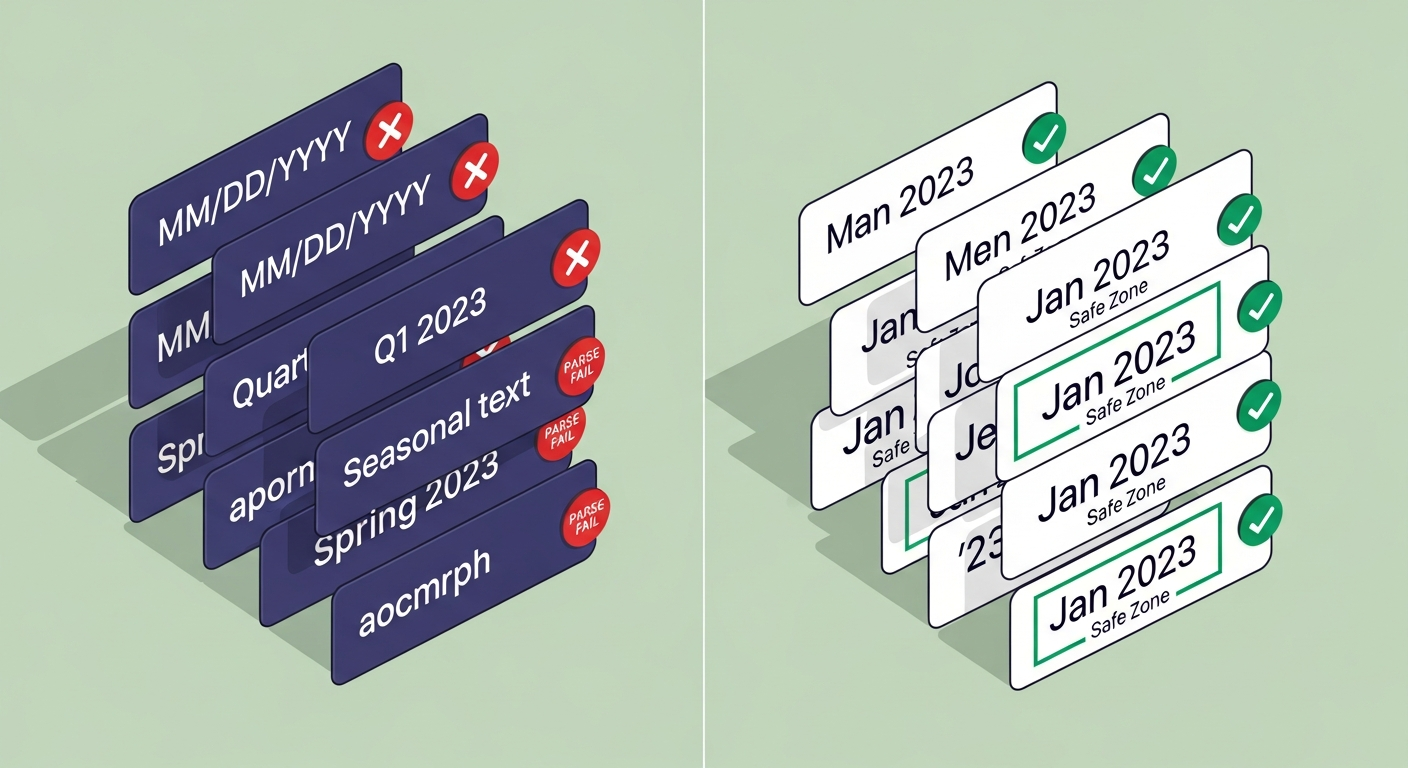
The safest date format, validated across Greenhouse, Lever, Workday, Taleo, and iCIMS in our weekly testing:
Jan 2022 – Mar 2024
Three-letter month abbreviation. Four-digit year. En dash or hyphen between them. "Present" for current roles.
What goes wrong with other formats:
- 1/2022 – 3/2024 — slash-separated dates confuse most parsers. Some read this as January 22, 2020. Others return null and skip the entry.
- 2022 – 2024 — year-only loses month precision. The ATS may calculate partial experience credit or miscalculate tenure by a full year.
- Q1 2022 – Q1 2024 — quarter notation isn't in most ATS date parsers. Scores as null.
- Winter 2022 – Spring 2024 — seasonal dates parse to nothing on every major platform.
- 2022' – 2024' — apostrophes in date fields cause tokenization failures in Taleo specifically. A common error in resumes imported from design templates.
- February 2022 – March 2024 — full month names work on most platforms but occasionally fail on older Taleo and iCIMS installs. The three-letter abbreviation is universally safe.
Rule of thumb: if you can't write "Jan 2022 – Mar 2024," write the full month name. Never use slashes, quarters, seasons, or apostrophes in date fields. "Present" is universally recognised for current roles — don't write "Now" or "Ongoing" or leave the end date blank.

How Far Back Your Work History Should Go
10 years. That's the standard rule of thumb, and it's a reasonable one. Most ATS platforms weight recent experience more heavily than anything before 2015, and job titles from 2005 often don't map cleanly onto the terminology in current job descriptions.
"Webmaster" (2003) scores poorly against "Web Developer" (2024 job description). Not because you weren't doing the work — because the parser is doing exact-match keyword scoring against a job description that was written this year.
Three reasons to stop at 10 years:
- Older titles drift. The ATS looks for the current term, not the 2008 equivalent.
- Companies that no longer exist can't be verified in background checks, which creates friction at the offer stage.
- Every line spent on a 2004 job is a line that could hold a keyword from the job description you're targeting right now.
One exception: relevant credentials. If you have a certification, a named employer, a specific technical project, or a job title that appears in the job description — and it's from 15 years ago — include it. The ATS is looking for the keyword. It doesn't care about the vintage. Exclude it from the main chronology if you want, but capture the keyword somewhere in the document.
Early-career candidates with fewer than 10 years of professional experience: go back as far as you have. Internships count. Volunteer roles with real responsibilities count. The ATS needs data to calculate experience — an empty chronology scores as zero.
Free ATS Score Check
Your result looks like this —
get yours in 30 seconds.
Drag & drop your resume here
PDF or Word · max 10 MB
Results in under 30 seconds · no sign-up required

Bullet Points That Pass ATS and Impress Recruiters
Every bullet in your work history is a keyword delivery vehicle. The ATS extracts verb and object from each bullet. The recruiter scans for the verb and the number. Write for both at the same time.
The structure that works on every platform:
[Action verb] + [what you did] + [measurable result]
"Managed customer escalations, reducing average resolution time by 22%" — the ATS extracts "managed" and "customer escalations." The recruiter sees the 22%.
3–5 bullets per role. Fewer and you're missing keyword opportunities. More and you're burying the signal in volume. For roles older than five years, 1–2 bullets is enough — just enough to hold any transferable keywords.
The keyword matching problem is more precise than most candidates realise. A project manager applied for a role listing "stakeholder communication" as a required skill. Her resume said "cross-functional collaboration" — which means the same thing to a human, and to no ATS ever built. The system looked for "stakeholder communication," found zero matches, and scored her accordingly. She was filtered before the recruiter saw her name.
She changed two phrases. Got the interview. Got the job.
The fix: mirror the job description's language in your bullets, not your preferred phrasing. If the job description says "stakeholder communication," your bullet says "managed stakeholder communication." Not a synonym, not a paraphrase. The exact phrase.
Soft skill bullets — "demonstrated strong communication," "collaborated effectively," "showed leadership" — score nothing. The ATS ignores them. List hard skills in your dedicated skills section; prove soft skills with results numbers in your bullets.
How to Handle Employment Gaps in Your Work History
A gap in your work history isn't a problem on the ATS side — it just pauses the experience calculation for that period. What matters is how you handle it in the document.
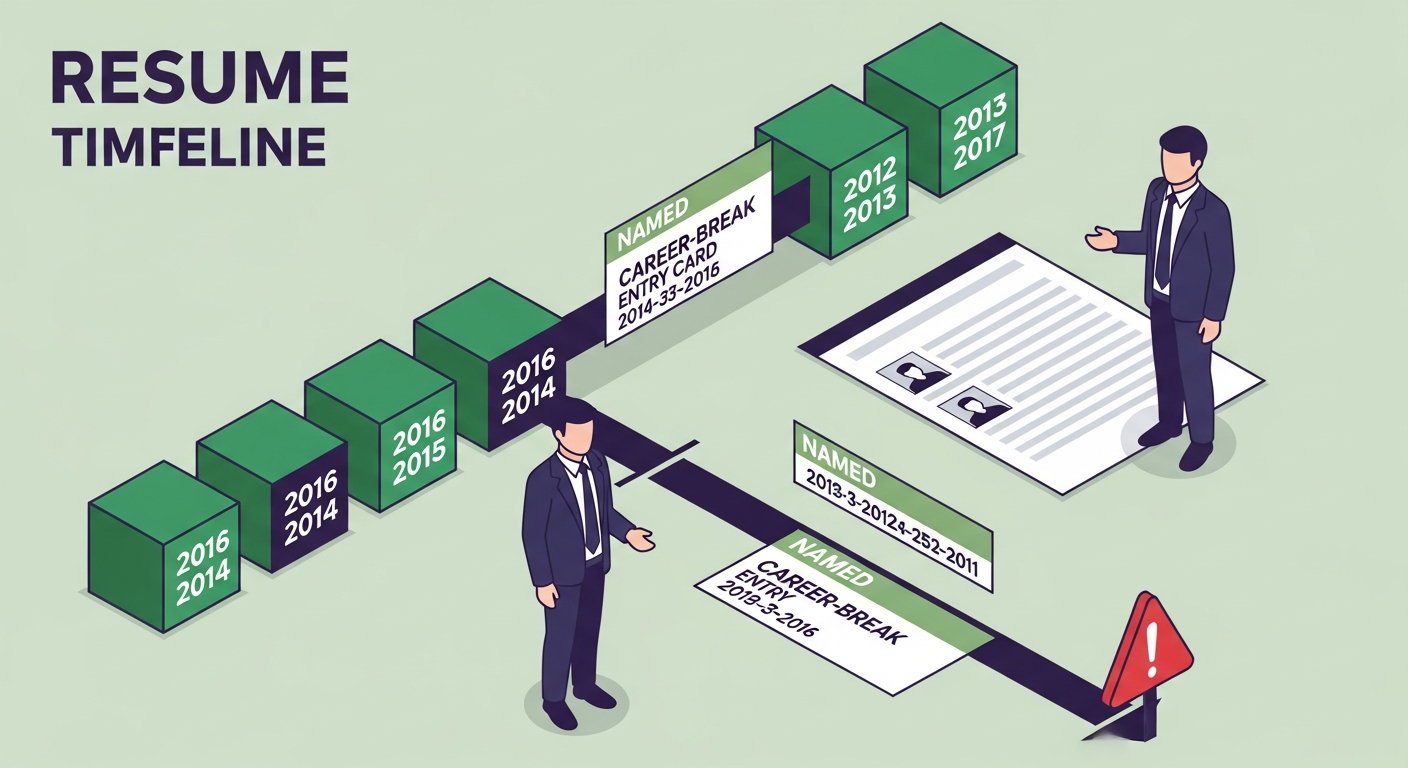
Don't leave blank space. Blank space in a chronology is invisible to the ATS and suspicious to the recruiter. The algorithm finds no entry, calculates a gap, and reduces your calculated experience total. The recruiter sees an unexplained hole and has to fill it with assumptions. They will fill it with the worst assumption available, because the alternative is spending time researching someone who might be hiding something.
The solution: list the gap as a named entry with a date range.
"Career Break — Family Caregiving, Mar 2022 – Sep 2023"
The ATS parses this as a date-ranged entry. The experience calculation sees a named role in the slot and moves on. The recruiter sees an explanation.
A candidate with an 11-month employment gap — a year caring for a sick parent — listed it exactly this way, then spent two sentences in her cover letter on it. Not a problem at any of the four companies that interviewed her. One hiring manager told her directly: "We care that you explained it. We don't care that it happened."
The gap that destroys applications is the unexplained one.
Other valid gap labels: "Career Break — Relocation," "Career Break — Medical Leave," "Freelance Consulting" (if you did any project work), "Full-Time Caregiver." The label doesn't need to be elaborate. It needs to exist.
Special Cases: Multiple Jobs, Freelance, and Short Stints
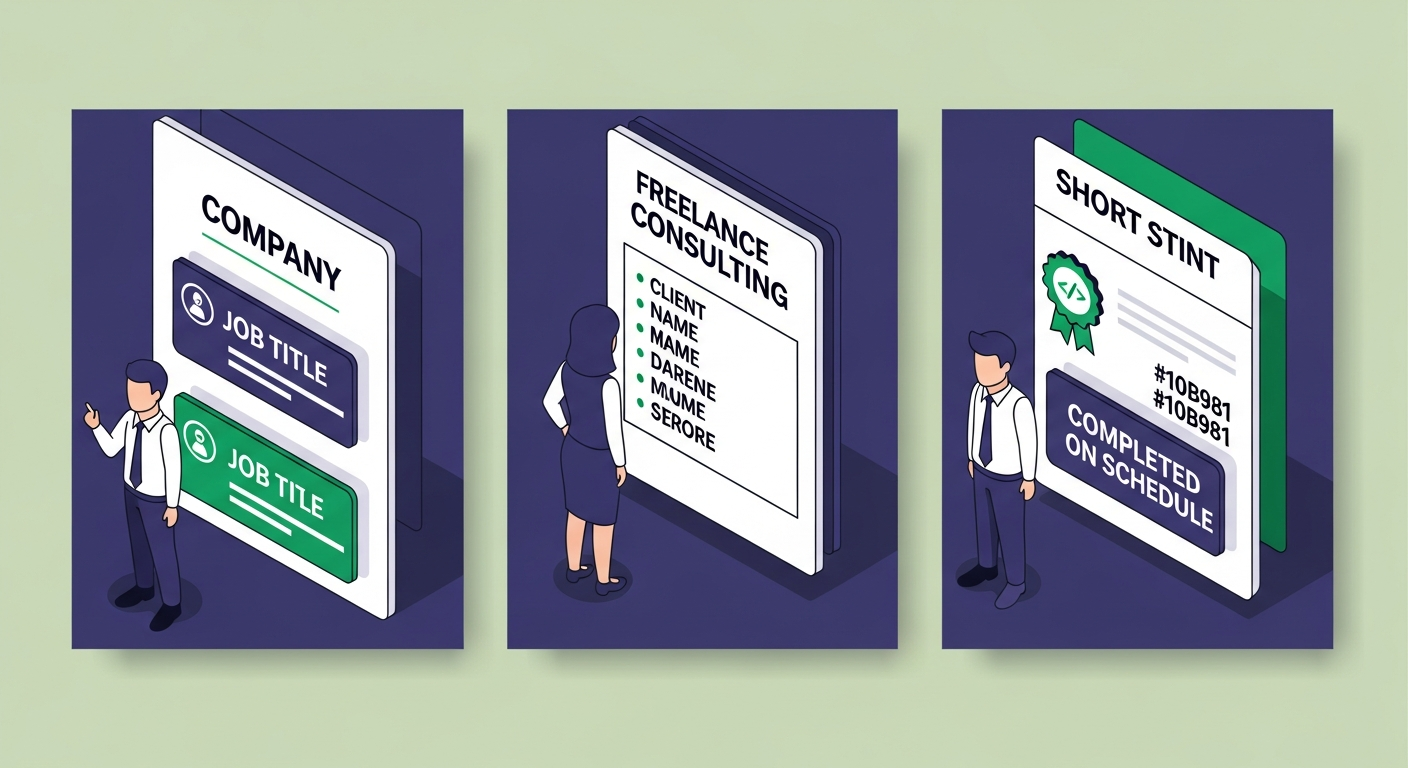
The standard work history structure handles three common situations less obviously than the basic format suggests.
Multiple roles at the same company: List each title separately with its own date range, nested under the same company header. The ATS needs to see each title as a distinct field to extract it correctly. Don't merge them into a single entry with a dash-separated title like "Analyst → Senior Analyst → Manager" — the parser reads this as one unusual job title and scores it against none of your target roles.
Freelance and self-employed work: Use "Freelance [Job Title]" or "[Your Name] Consulting" as the employer name. Include real clients in the bullets if they're recognisable — "Advised clients including [Company A] and [Company B] on..." names keywords the ATS can extract and the recruiter can verify. Cover the full period with a single date range. Don't leave freelance years as blank space — the experience calculation will read it as a gap, and a gap of two or three years without an entry is the kind of thing recruiters ask about specifically.
Short stints under a year: Include them if they're relevant and recent. Omitting a three-month contract creates an unaccounted gap that looks worse than the job that filled it. A brief explanatory phrase in the bullets — "contract role, project completed on schedule" or "fixed-term contract, client reduced headcount" — handles the brevity without requiring an explanation elsewhere. What you don't want is a blank space where a relevant keyword and a date range used to be.

When These Rules Don't Apply
Three situations where ATS work history formatting matters less:
Small companies under 50 people. Most companies this size don't run Greenhouse or Workday. A human reads your resume first. The parsing penalty disappears. Structure still matters for clarity — a recruiter who can't follow your work history chronology won't spend long on it — but the algorithm isn't the reader.
Applying through an agency recruiter. Agency recruiters often pull candidates based on keyword searches in their own database, then reformat your resume into their template before sending it to the employer. Your original formatting is replaced. The keywords still matter; the structure you chose is often discarded anyway.
An internal referral. If someone at the company submits your resume through their employee referral portal, it typically bypasses the ATS queue entirely or scores you higher regardless of formatting. Network your way to the referral first, then worry about keyword optimisation for the roles where you're applying cold.
Honestly, if you're applying cold to a mid-size or large employer through their careers page, assume ATS. 98% of Fortune 500 companies use one. The safe play is to optimise as if the algorithm is always watching — because most of the time, it is.
What still applies everywhere: the job title match, accurate date ranges, and bullet points that contain the phrases from the job description. Even humans want to know what you did and whether it worked. The work history section is where you prove both.
You made it to the end of an article about resume work history formatting. You have more patience than the average job seeker. Now go fix the dates.
Related from ATSFixer
Frequently Asked Questions
A history resume refers to the work history section — the part of your resume that lists your previous jobs in reverse chronological order. It typically includes your job title, employer name, location, employment dates, and 3–5 bullet points per role describing your responsibilities and results.

Jordan Marcus
Senior Career Strategist
Jordan has reviewed 4,000+ resumes and coached candidates into roles at Google, Stripe, and McKinsey. She writes about the mechanics of ATS and what actually gets people interviews.