On this page
- Why Most Self-Descriptions Get Filtered Before Anyone Reads Them
- How ATS Scores Your Professional Summary
- How to Describe Yourself in a Resume Professional Summary
- How to Describe Yourself in an Interview
- Words That Score on ATS and Words That Score Zero
- How to Describe Yourself at Every Career Stage
- When Your Self-Description Doesn't Need to Pass an Algorithm
How will I describe myself professionally — in a resume, a job application, an interview? It sounds like the kind of question you'd work through in front of a mirror, rehearsing stories about your strengths. And eventually, you will answer it in a room with a human across a table.
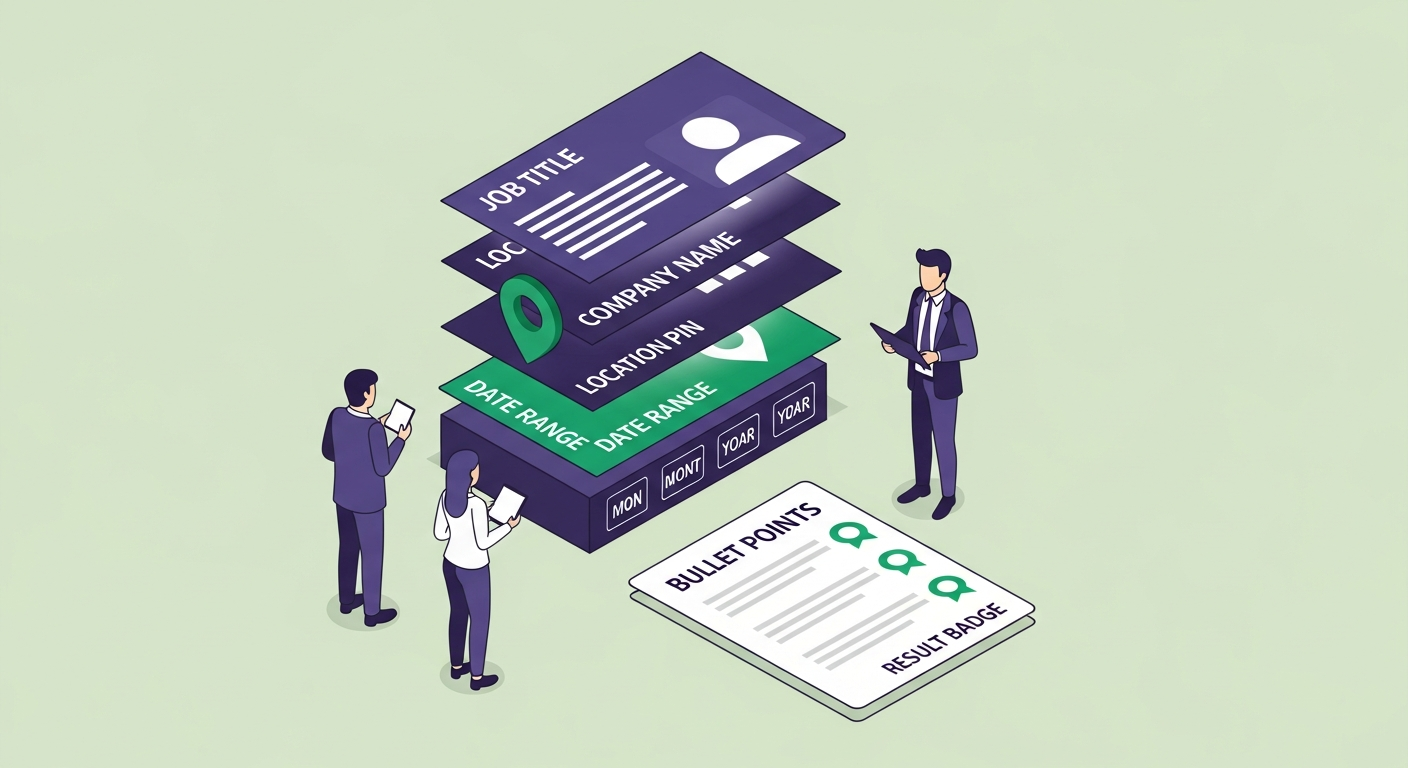
The part nobody tells you: before you get to that room, your written self-description gets scored by a machine. Your resume's professional summary is one of the first sections an Applicant Tracking System parses. It extracts keywords, measures how closely they match the job description, and assigns a number — before any recruiter opens your file. A well-crafted paragraph full of phrases you'd use to describe yourself can still score 20/100 if those phrases don't match the exact vocabulary of the posting.
According to Jobscan research, 75% of resumes are filtered by ATS before a human reads them. Your professional summary is usually in that 75%. (I know. Not exactly the inspiring opener you were hoping for. But this is the conversation nobody else is having with you, so here it is.)
This guide covers both: the written self-description that has to pass algorithmic screening to get your name on a list, and the spoken version that earns you the offer once you're in the room. Same person, same story — two very different audiences, two very different formats.

Why Most Self-Descriptions Get Filtered Before Anyone Reads Them
The question isn't "how will I describe myself?" — it's "who am I describing myself to first?" Most job seekers skip that part. They write a professional summary for a human reader and unknowingly lose to the algorithm that reviews it before the human arrives.
The mechanism is straightforward. A recruiter at a mid-size company sorts the ATS queue by score and reads the top 15. The score cutoff is roughly 65/100. Everyone below that mark is never opened — not because she decided they were unqualified, but because the queue is too long to read past position 15. She didn't filter you. The ranking did, before she sat down.
The ATS scores you on keyword matching. It does not score you on authenticity, writing quality, or the fact that you "thrive in fast-paced environments." A professional summary that reads "cross-functional collaborator with a talent for stakeholder alignment" sounds polished. If the job description says "stakeholder communication" and "program management," your polished summary scored zero on both. Cross-functional collaborator and stakeholder communication mean exactly the same thing to a human. The ATS treats them as two different strings and awards points for the one that matches its indexed phrase.
A 2021 Harvard Business School and Accenture study of 8 million job postings found that 88% of executives acknowledged their ATS filters out qualified candidates who should have made it through. The executives know. Most haven't changed the system, because reviewing 250 applications manually isn't operationally viable. The better move is understanding the filter well enough to pass it — which starts with your professional summary.
How ATS Scores Your Professional Summary
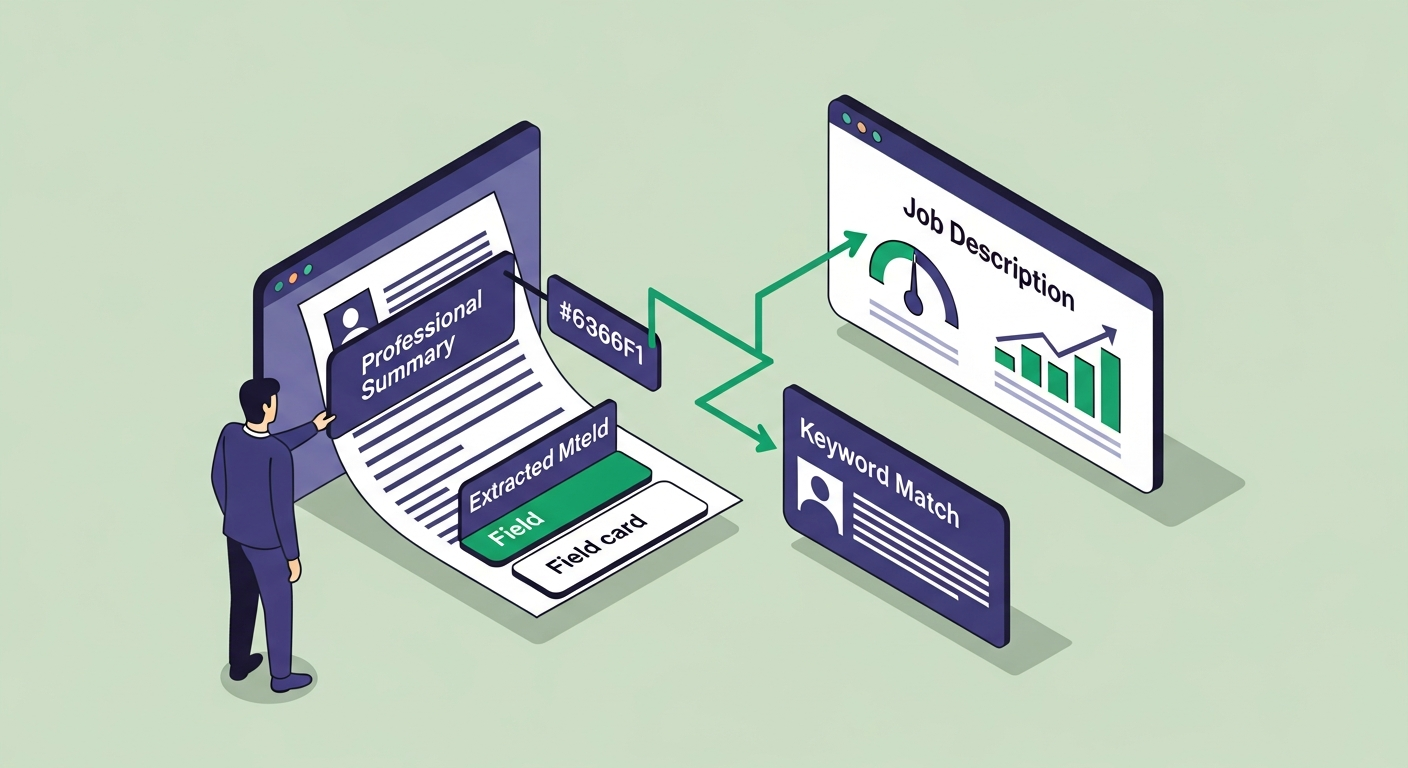
When an ATS parses your resume, it extracts your professional summary into a dedicated data field. This field is indexed separately from your work history bullets. What you write there gets weighted twice: first as a stand-alone section, then as part of the full-text keyword scan across your entire document.
Keywords that appear in both your summary and your work history bullets score higher than keywords appearing only once. ATSFixer internal testing confirms that most platforms — Greenhouse, Lever, Workday, and Taleo included — weight keyword frequency and placement. Dropping "data analysis" into your summary and three bullet points outscores a single mention, even if the phrase appears in your job title.
What the algorithm is specifically looking for in your professional summary:
- Exact-match job title terms. If the role is "Data Analyst" and your summary says "analytics professional," that's a partial miss. The system scores the title as it appears in the job description.
- Hard skill keywords from the job description. Software names, certifications, tools, methodologies — in the exact phrasing the posting uses, not your preferred synonym.
- Seniority signals. Phrases like "5+ years" or "senior-level" or "team lead" map to experience filters recruiters set in the ATS before they ever look at individual candidates.
What it does not score: your story, your personality, your conviction, or the fact that you "bring passion to everything you do." (A phrase that has appeared on roughly 30% of the resumes I've reviewed. It has helped none of them.)
Job seekers who tailor their resume to each application are 3× more likely to get an interview, according to a Jobscan analysis of 1M+ resume scans. The tailoring that moves the needle is keyword matching in the summary and the skills section — not a rewrite of your entire document.
How to Describe Yourself in a Resume Professional Summary
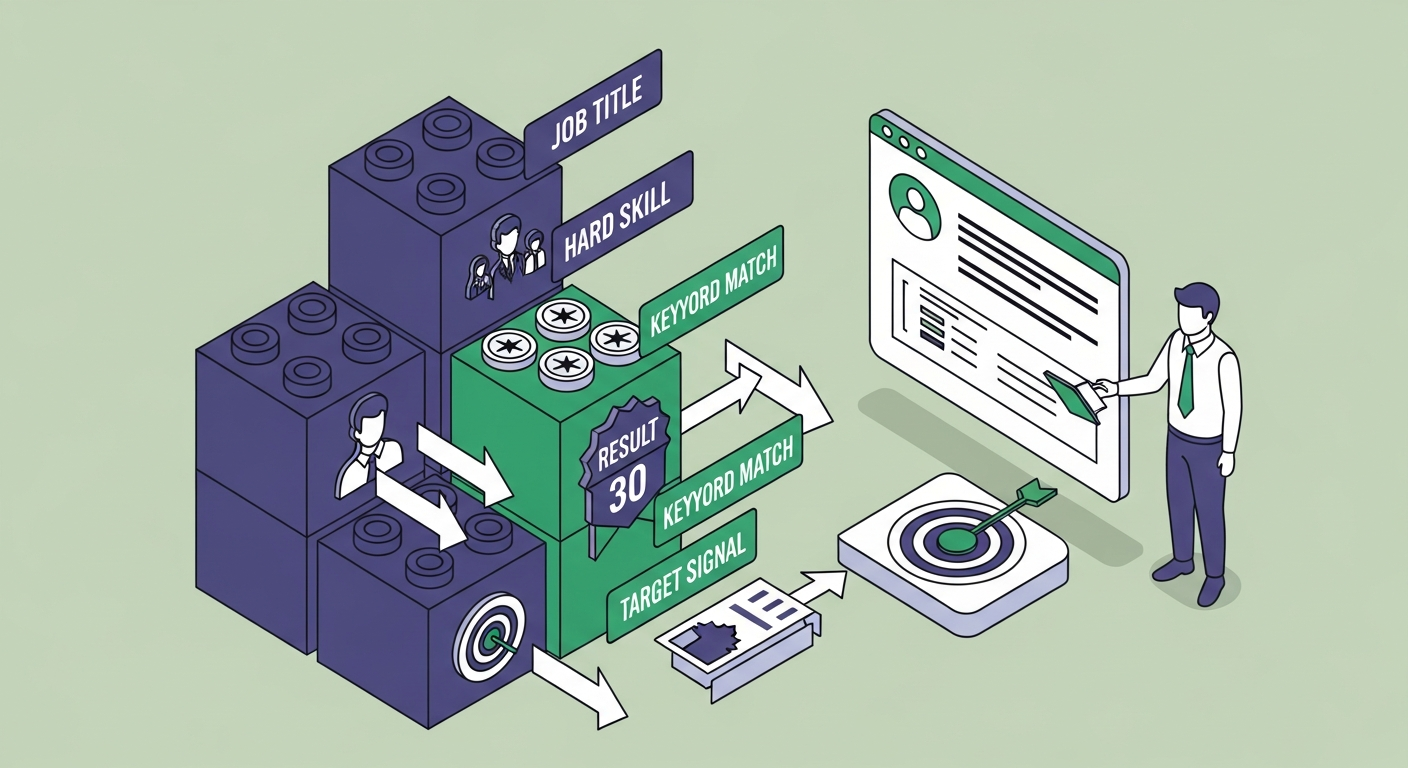
A resume professional summary has one job: signal clearly to the ATS what role you fill, what you're capable of, and that you're worth reviewing. Three to four sentences. No more.
The structure that works:
- Sentence 1 — Job title + years + specialization. Mirror the job description's exact language. If the posting says "Account Executive," write "Account Executive." Not "revenue-focused relationship builder." The title.
- Sentence 2 — Your two or three strongest hard skills in exact-match phrasing. Check the job description. Use those words. Put them here first, not buried in bullet points you wrote two years ago.
- Sentence 3 — A result or credential that proves the claim. A number, a certification, a company name that signals seniority. "Managed $2M in annual client accounts" does what "results-oriented" can't.
- Sentence 4 (optional) — What you're seeking. A single phrase: "Seeking a senior-level operations role in high-growth SaaS." This feeds seniority and industry filters some platforms use to rank candidates before a recruiter even views results.
Example for a mid-career project manager:
Before (reads well to a human, scores low on ATS):
"Versatile, deadline-driven professional with a passion for problem-solving and a track record of delivering results across complex teams and stakeholder groups."
After (reads clearly, scores better):
"Project Manager with 7 years of experience in agile software development environments, including Jira, Confluence, and cross-functional stakeholder communication. Delivered 14 product launches on time and within budget across enterprise SaaS clients."
The difference: the second version contains five terms that appear directly in most mid-market PM job descriptions. The first contains zero exact-match hard skill terms — just adjectives, which the algorithm treats as noise.
A quick gut check before you finalize: paste your summary next to the job description and count how many phrases appear in both. Fewer than three means you've written a personal statement. Personal statements don't score.
For a deeper look at how resume introductions work across career stages, see our guide on resume introduction examples.

How to Describe Yourself in an Interview
"Tell me about yourself" is not a small talk opener. It's a test of whether you know why you're in the room — and whether you can explain it without reading from your resume.
The formula that works whether you're on video or in person:
- Present: What you do now and what you're good at. One sentence. "I'm a senior operations manager at a mid-size logistics company, where I oversee supply chain coordination and vendor contracts."
- Past: The thread that explains how you got here. One sentence. "Before this role, I spent five years at a 3PL firm scaling warehouse operations from two to twelve sites across the Southeast."
- Future: Why this opportunity, specifically. One sentence. "I'm looking to move into a VP-level role where I can build the process infrastructure from the ground up rather than inheriting it."
Keep it to 90 seconds. A tight answer that lands on "future" signals preparation and confidence. A rambling one that ends on something that happened eight years ago makes them wonder if you know where you're going.
What doesn't work in an interview self-description:
- "I'm a hard worker." Every candidate in the queue says this. It says nothing about you that distinguishes you from the person scheduled after you.
- Starting with "So, I graduated from..." Past-only framing. Puts your most outdated credential first and leaves the interviewer waiting to find out why any of it matters now.
- Reading your resume. The interviewer has your resume. They're waiting to hear the story that connects the jobs — not a read-aloud of the document they spent 7.4 seconds reviewing before you walked in.
The interview version of "how will I describe myself" is about the connective story between your experience and the role. The resume version is about the keywords that got you in the door for that conversation. One needs craft. The other needs matching. Both matter.
Free ATS Score Check
Your result looks like this —
get yours in 30 seconds.
Drag & drop your resume here
PDF or Word · max 10 MB
Results in under 30 seconds · no sign-up required
Words That Score on ATS and Words That Score Zero
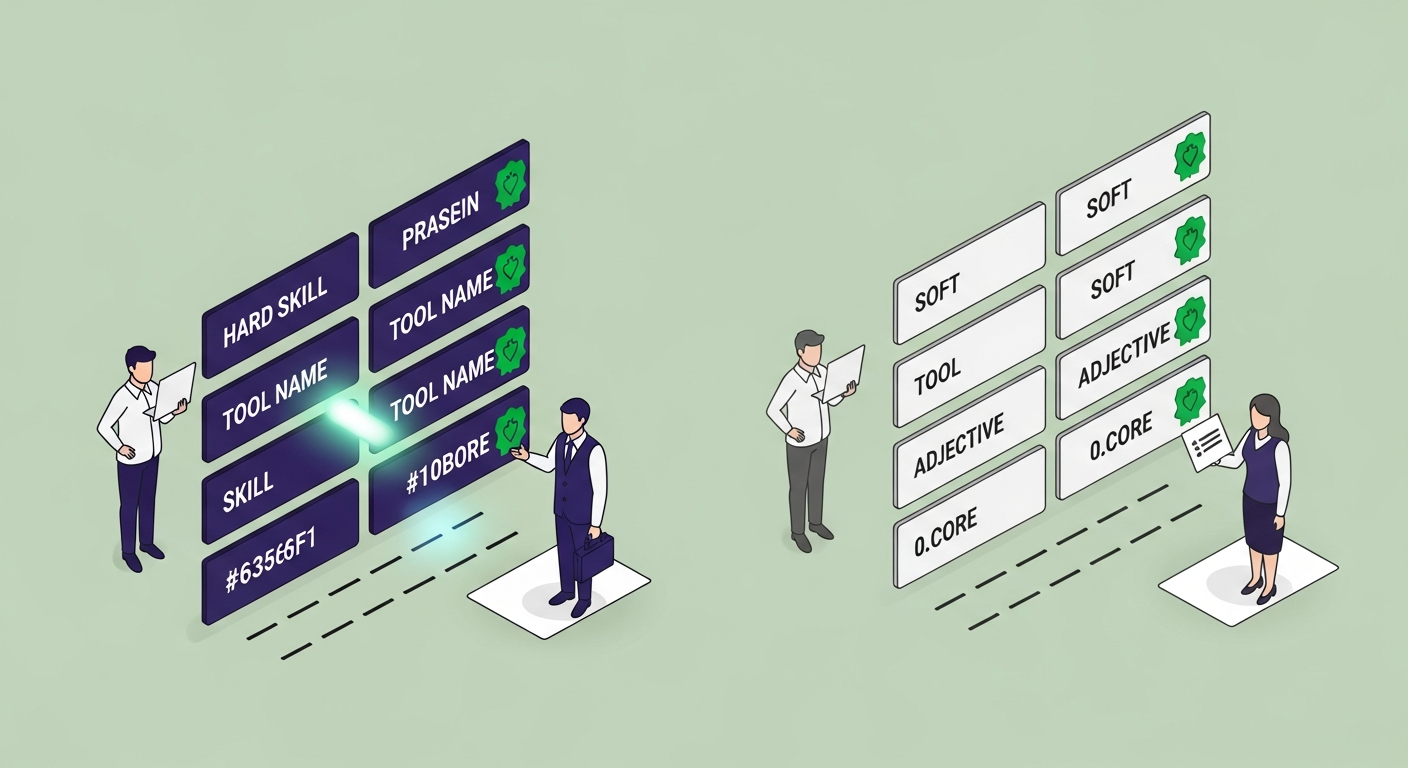
The most common self-description words on resumes — "hardworking," "detail-oriented," "team player," "passionate," "self-motivated" — score exactly zero on ATS. Every applicant uses them. The algorithm learned to ignore them years ago and hasn't changed its mind since.
What scores on ATS:
- Hard skill names in exact phrasing. "Python," "Salesforce," "SQL," "Adobe Creative Suite," "PMP certification" — the tool, platform, or credential as it appears in the job description, not your synonym for it.
- Job title terms. "Product Manager," "DevOps Engineer," "Registered Nurse," "Senior Counsel" — the exact title the posting uses, not a creative variant that means the same thing.
- Methodology and framework names. "Agile," "Scrum," "Lean Six Sigma," "GAAP," "HIPAA compliance" — each one is its own exact-match token. The ATS doesn't know that "iterative delivery methodology" is what you call Agile.
- Measurable outputs. Numbers survive parsing better than most terms because they don't compete with synonyms. "Reduced churn by 18%" scores cleanly. "Significantly improved retention" scores nothing.
What scores nothing:
- Soft-skill adjectives: "dynamic," "innovative," "versatile," "proactive," "synergistic" (I haven't seen "synergistic" in a while — hopefully it retired)
- Generic claims: "excellent communication skills," "strong leadership ability," "works well under pressure"
- Phrases designed to sound impressive: "results-driven professional," "outside-the-box thinker," "goes above and beyond"
The fix isn't to remove soft skills from your self-description entirely — it's to prove them through specific outcomes in your bullet points rather than assert them in your summary. "Led a team of 8 to reduce customer escalation time by 31%" proves leadership and communication. "Strong leader with excellent communication skills" proves neither, to the algorithm or the recruiter.
Resumes with a dedicated skills section score an average of 10–15 points higher on ATS screening than equivalent resumes without one (ATSFixer internal data). Your summary introduces the keywords. Your skills section confirms them. Used together, they score better than either would alone. For more on which words actually move the needle, see our guide on adjectives for resume: which words actually score.

How to Describe Yourself at Every Career Stage
The answer to "how will I describe myself" changes depending on what's behind you. What works for a project manager with 12 years of experience doesn't work for someone applying for their first job. The structure is the same; the content weight shifts.
Entry-Level and No Work Experience
You can't lead with years of experience you don't have. Lead with credentials and relevant skills instead. If you have a degree, a certification, a project, or a meaningful internship, those are your opening act.
"Recent Computer Science graduate with hands-on experience in Python, SQL, and data visualization through three independent projects and a six-month internship at a fintech startup."
That scores on three hard skills and signals recent, relevant exposure without fabricating experience. Compare it to: "Eager, motivated recent graduate looking for an opportunity to grow." That describes roughly 100% of recent graduates who apply to anything. It doesn't help the algorithm, and it doesn't differentiate you to the recruiter on the other end.
Mid-Career Professionals
Lead with job title, years, and specialization. Then add exact-match skills and a quantified result. "Senior Marketing Manager with 8 years in B2B SaaS, specializing in demand generation, HubSpot, and account-based marketing. Scaled pipeline from $3M to $12M annually over three years."
Every word in that summary maps to a filter a recruiter would set in Greenhouse before the queue is even displayed. Job title, seniority level, industry vertical, tool name. The result closes the deal for the human reviewer.
Career Changers
The challenge is vocabulary mismatch. Your experience is real. The language your old industry used is not the language your new industry scores. A teacher transitioning into instructional design needs to translate "curriculum development" into "learning experience design," "student assessment" into "training effectiveness measurement," and "classroom management" into "facilitation."
The algorithm doesn't understand career transitions. It doesn't know that your skill is the same skill — only that your vocabulary is different. Translate before you submit. For a deeper framework on making this translation, see our guide on how to make a resume stand out, which covers the ATS-first approach to standing out during a transition.
When Your Self-Description Doesn't Need to Pass an Algorithm
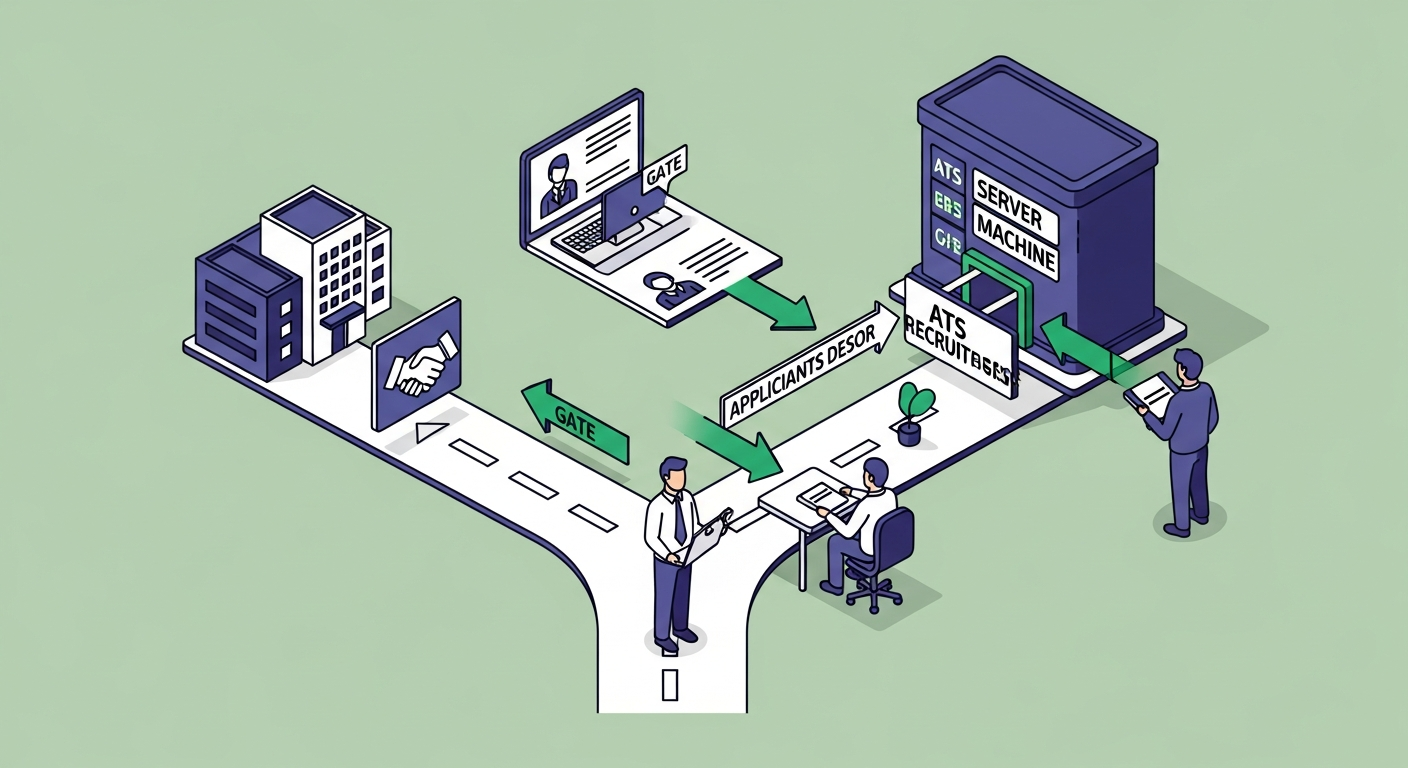
98% of Fortune 500 companies use an ATS. Most companies under 50 people don't. The keyword advice in this post applies primarily to mid-size and large employers running Greenhouse, Workday, Lever, Taleo, or iCIMS. Here's when the stakes change.
Small companies and early-stage startups. At a 15-person startup, your resume is read first by a founder or a department lead with a startup-sized inbox — not filtered by a scoring system. A well-written professional summary that makes a strong human impression outperforms a keyword-dense one that reads like a spec sheet. Focus on clarity and specificity rather than exact-match phrasing.
Agency recruiters. If a recruiter is placing you, they typically extract your skills and reformat your resume into their house template before sending it to the client. Your layout and even your summary language is often rewritten before it reaches the hiring manager. Keywords still matter — the recruiter is doing keyword matching manually when they search their database. But the ATS filter you're optimising against is usually the recruiter's own system, not the employer's.
Internal referrals. If someone at the company submits your name through an employee referral program, your application typically bypasses the standard ATS queue or receives a scoring boost regardless of keyword match. Get the referral first. Refine the keywords if you still need to apply through the careers page afterward — but don't spend time optimising for a filter you've already cleared.
Honestly: when in doubt, optimise for ATS. The cost of a keyword-matched summary to a human reader is low — it reads clearly when you use real job titles and skill terms instead of vague adjectives. The cost of a human-optimised summary to the algorithm is 75% of applications filtered before anyone sees your name. That's not a coin flip worth taking.
For a complete picture of how the machine processes your application from the moment you hit submit, see our guide on how ATS systems work.
You made it through an article about describing yourself to machines before you describe yourself to people. The irony is not lost on me. Now go write a summary the algorithm can score — and save the personality for the room where the humans are.
Related from ATSFixer
Frequently Asked Questions
Start with your job title, years of experience, and top two or three hard skills — using the exact vocabulary from the job description you're targeting. Then add a quantified result or credential that proves the claim. For your resume, this becomes your professional summary. For an interview, it becomes the first half of your "tell me about yourself" answer.

Jordan Marcus
Senior Career Strategist
Jordan has reviewed 4,000+ resumes and coached candidates into roles at Google, Stripe, and McKinsey. She writes about the mechanics of ATS and what actually gets people interviews.