On this page
- What You Already Have That Counts
- The Format That Works With No Work History
- How to Write a Resume Summary With No Experience
- How to List Skills When You Have No Job History
- The Sections That Replace Work Experience
- Internships
- Volunteer Work
- Projects
- Relevant Coursework
- What ATS Actually Does With No-Experience Resumes
- When ATS Keyword Optimization Matters Less
- Mistakes That Get No-Experience Resumes Filtered
- Frequently Asked Questions
Here's the honest answer to how to make a resume with no work experience: it's a formatting and placement problem, not an experience problem. You already have things that ATS systems and recruiters will read as relevant. The question is whether you've structured them in a way the algorithm can parse — or buried them in a two-column template that looks good as a thumbnail and scores 0 in Workday.
The guide below covers what to include, in what order, and why ATS behaves differently when your work history section is empty. Which it does. Nobody mentions that part.

What You Already Have That Counts
Before the format, let's establish something: "no work experience" almost never means no experience. It usually means no paid employment — which is a much smaller box.
Things that count as relevant experience on a first resume:
- Internships — paid or unpaid, short or long
- Volunteer work — especially if you held a defined role or drove a measurable outcome
- Class projects — particularly any with a real output: a working app, a market analysis, a designed campaign that was actually used
- Extracurricular leadership — club officer, team captain, event organiser
- Freelance or gig work — tutoring, building websites for family friends, selling anything to anyone online
- Personal projects — GitHub repos, newsletters, YouTube channels, anything with a tangible output and a real audience
The recruiter reviewing your resume doesn't need a W-2. They need evidence that you've done something relevant and done it reasonably well. The list above produces that evidence. The gap in your "Work Experience" section is a presentation problem, not a disqualification.
The job is to present what you have in the structure ATS expects — and that's where most no-experience resumes fall apart. (More on this in the ATS section below, because it's more specific than most guides let on.)

The Format That Works With No Work History
You'll find advice online recommending a "functional resume" for candidates with no experience — one that leads with skills and removes or buries the work timeline. Don't do this.
Functional resumes score poorly on every major ATS platform. Greenhouse, Workday, and Taleo all parse resumes by looking for structured sections: header, summary, experience, education, skills — in roughly that order. A functional format disrupts that structure and produces a garbled extraction. In ATSFixer's internal testing, functional-format resumes consistently score 15–25 points lower than reverse-chronological versions with identical content.
Use a reverse-chronological format with three adjustments for no-experience candidates:
- Move Education above the Experience section
- Rename "Work Experience" to "Relevant Experience" — and fill it with internships, projects, and volunteer roles
- Use a single-column layout — no sidebars, no text boxes, no columns
The two-column layout deserves its own moment because it's the most common formatting mistake I see. ATS parsers read left to right in a single pass. A two-column resume merges your skills sidebar with your job titles into garbled text. In ATSFixer testing, 1 in 3 resumes submitted through Workday are corrupted during parsing because of columns, tables, or text boxes. A software engineer with 8 years of experience submitted a beautifully designed two-column resume and scored 12/100. He converted to a single column. Same content, no design changes beyond layout. Score: 71/100. Interview that week.
If you're starting from scratch, use a simple Word or Google Docs template — the most boring one available. Boring parses.
How to Write a Resume Summary With No Experience
The resume objective — "Seeking a challenging position where I can leverage my skills and grow as a professional" — has been functionally dead since roughly 2009. Recruiters skip it. ATS doesn't weight it. It takes up space that could have a keyword.
Replace it with a resume summary: two or three sentences that tell the recruiter who you are, what you bring, and what role you're targeting. Write it with keywords from the job description embedded naturally.
For a no-experience resume, a strong summary looks like this:
Marketing student at [University] with hands-on experience running social media campaigns for three campus organisations, reaching a combined audience of 4,200 followers. Proficient in Canva, Hootsuite, and Google Analytics. Seeking an entry-level marketing coordinator role where I can apply the content strategy work I've done outside the classroom.
Notice what that summary does: it names a specific skill set, includes a real number (4,200 followers), mentions relevant tools by name, and states the target role. Every word is working.
What it doesn't do: tell the recruiter you're a "hard worker," "fast learner," or "team player." Those phrases appear on the majority of resumes. The algorithm has learned to ignore them. Prove your qualities in your bullets — list tools and outputs in your summary.
Rule of thumb: write the summary last. Once you've listed your skills and experience bullets, you'll know what to highlight. Writing it first is the resume equivalent of writing the conclusion before the essay. (I know people who do that. Those people are wrong.)
How to List Skills When You Have No Job History
The skills section is the most under-used part of a no-experience resume. Most people either skip it entirely or fill it with "communication," "teamwork," and "attention to detail" — which is the resume equivalent of describing yourself as "a person who breathes." The algorithm doesn't care. Neither does the recruiter.
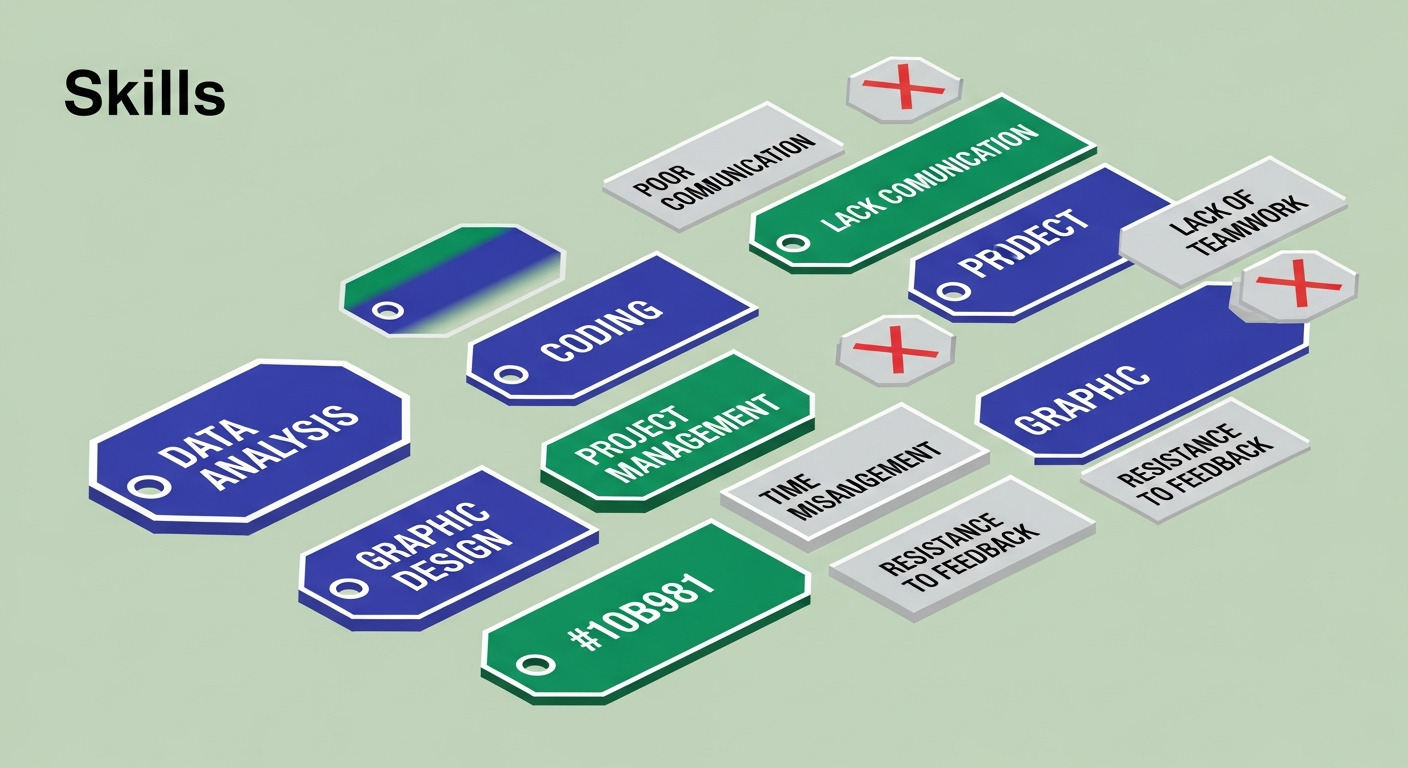
Here's why the skills section matters more for no-experience resumes than for anyone else: when you have no work history, ATS systems extract keywords disproportionately from your skills section. It's one of the few structured fields the parser reliably reads. Fill it with hard skills from the job description, and you give the algorithm something to score.
Two rules:
1. Hard skills only. Tools, technologies, platforms, certifications, languages. "Adobe Premiere Pro," "Python," "Google Ads," "Mandarin (conversational)," "CPR certified." These are specific and verifiable. Soft skills — "adaptable," "leadership," "critical thinking" — score nothing on ATS and read as filler to a recruiter. Prove those qualities in your experience bullets; list hard skills in your dedicated section.
2. Mirror the job description's exact language. If the posting says "project management," your skills section says "project management" — not "managing projects," not "overseeing timelines." ATS platforms do exact-match keyword scoring on most fields. Synonyms score zero. A project manager once applied to a role listing "stakeholder communication" as a required skill. Her resume said "cross-functional collaboration" — which means the same thing to a human, and to no ATS ever built. She was filtered before the recruiter saw her name. She changed two phrases. Got the interview. Got the job.
For a deeper look at how ATS weights different skill types and where to place them for maximum score, see our guide on what skills to put on a resume.
The Sections That Replace Work Experience
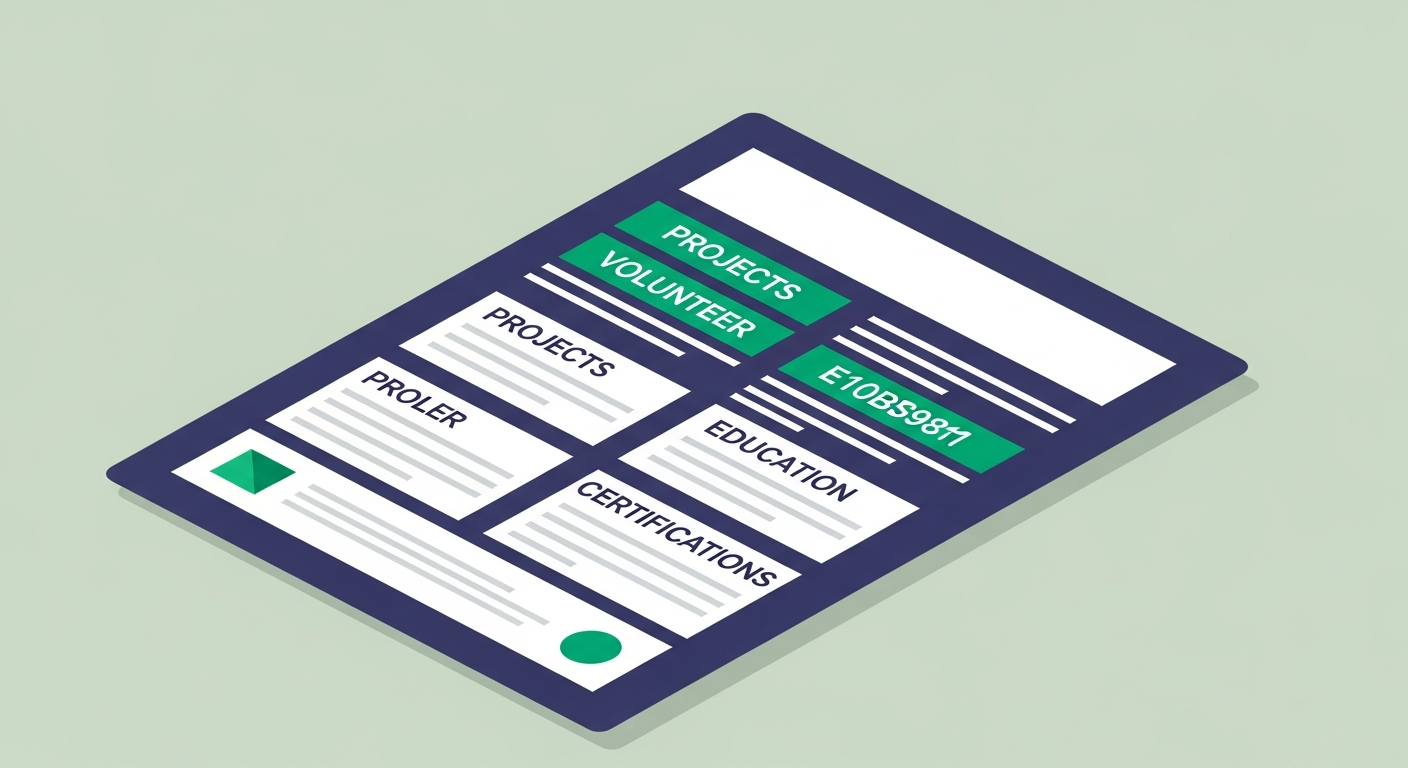
This is where a good no-experience resume gets built. The goal is to create entries that look, to an ATS, like structured work history — role, organisation, dates, bullet points using job-description language. What goes inside each entry is your business.
Internships
List these exactly like a job: organisation name, your role or title, dates, location, 2–4 bullet points. If you have an internship, it belongs at the top of your "Relevant Experience" section regardless of how short it was.
Write bullets with an outcome, not just a task. Not "Assisted marketing team with campaigns" — instead: "Supported three Instagram campaigns, contributing to a 12% follower increase over six weeks." If you don't have a precise number, estimate conservatively: "Developed weekly content calendar used across four social platforms."
Volunteer Work
Volunteer roles count as experience if you held a defined responsibility and produced a result. "Volunteer at food bank" is a sentence. "Logistics Coordinator, [Food Bank Name] — managed weekly inventory for 200+ household distributions, reducing waste through first-in-first-out rotation" is a resume bullet.
The distinction: did you do a task, or did you hold a role? If you held a role, write it like one. The algorithm doesn't know or care whether you were paid.
Projects
Class projects, personal projects, side projects — all fair game if they produced something real. A project entry looks like: project name, your role, dates, and 2–3 bullets on what you built and what happened as a result.
Personal projects especially: if you built an app, ran a newsletter, managed a social account above 500 followers, or started a small business selling anything to anyone, that's experience. Describe it in professional language and include any measurable output you have. "Side project" is a descriptor; what it produced is the evidence.
Relevant Coursework
This is specifically for roles that require a technical foundation you've built in school. A data analyst role listing SQL and statistics as requirements can be addressed with "Relevant Coursework: Database Management, Statistical Modelling, Business Intelligence" — listed below your degree, not as a separate section unless you have significant course depth to show.
Don't list every class you took. List only courses that map to requirements in the specific job description you're applying to. Three to six is usually the right range.
Free ATS Score Check
Your result looks like this —
get yours in 30 seconds.
Drag & drop your resume here
PDF or Word · max 10 MB
Results in under 30 seconds · no sign-up required
What ATS Actually Does With No-Experience Resumes
This is the part most guides skip, because most guides aren't written by people who run test resumes through Greenhouse and Workday every week. We do. Here's what actually happens.
When an ATS parses a resume with an empty or sparse work experience section, it doesn't penalise you for the absence. It looks for keywords wherever it can find them — skills section, education, project descriptions, summary. The problem is that most no-experience resumes have keyword-poor bullets. "Assisted the professor," "helped with events," "participated in research" — these phrases contain no role-specific language the algorithm can match to a job description.
According to Jobscan's analysis, the average job description contains 15–25 hard-skill terms. The average entry-level resume mirrors fewer than 5. That gap is why 75% of resumes are rejected by ATS before a human reads them — and it hits no-experience candidates disproportionately hard, because they haven't done the work of translating activities into job-description language.
The fix is mechanical: open the job description, list every specific skill, tool, and competency mentioned, then work through your resume section by section and match the language wherever it's truthful. Your volunteer coordination becomes "project coordination." Your campus newsletter becomes "content strategy." Your group presentation becomes "stakeholder communication." Same activities. Different words. Different score.
One candidate — no paid work history, one short internship, two class projects — was sending the same resume to entry-level marketing roles for three weeks. Zero callbacks. She ran it through ATSFixer, found she was matching fewer than four keywords per application, and rewrote her project bullets and skills section with language pulled directly from each posting. Within a week, she had two phone screens. Same experience. Different words.
This is also why understanding what keywords to put on your resume and how to place them applies with extra force when you don't have a decade of job titles carrying your keyword weight. You can check your ATS score with ATSFixer before applying — it shows exactly which keywords from a job description are missing from your resume, and where to add them.
To understand the mechanics behind why ATS makes these decisions, our post on how ATS systems work covers the full picture — including why the same resume scores differently across Greenhouse, Workday, and Taleo.

When ATS Keyword Optimization Matters Less
Part of this site's deal is telling you when not to use it. So: if you're applying to a company with fewer than 50 employees, there's a reasonable chance no one is running your resume through Workday. Small companies frequently hire through email, referrals, and direct outreach — and in those cases, the person reading your resume is a human, probably the hiring manager, probably within 48 hours of your application.
For small companies, human readability matters more than keyword density. Clear layout, strong first impression, honest representation of what you've done. The advice in this guide still helps — mirroring job-description language never hurts — but it's not the make-or-break factor it is at a company running Greenhouse.
How to tell the difference: if the job is posted through an application form that asks you to upload a resume, there's probably an ATS. If the application is "email your resume to [founder]@[startup].com," there almost certainly isn't. A SHRM report on small employer hiring found that most companies under 100 employees don't use formal ATS software. Adjust your strategy accordingly.

Mistakes That Get No-Experience Resumes Filtered
The Canva template. This is the one worth dwelling on. Most resume templates on Canva, Pinterest, and Etsy are not ATS-compatible. They use columns, text boxes, decorative headers, and graphics that break every major parser. A 2022 TopResume survey found that 63% of recruiters reject resumes due to formatting issues — and the formatting issues almost always come from templates that look impressive in a screenshot and score 8/100 in Workday. Use a plain Word or Google Docs format. The most boring template available is the right answer.
Soft skills in the skills section. "Team player," "detail-oriented," "fast learner." The algorithm has read these on the majority of resumes it's processed. It doesn't score them. Use that space for tools, platforms, and technical competencies. Prove the soft skills in your experience bullets.
The generic objective statement. "Seeking a challenging opportunity to leverage my skills in a fast-paced environment" — every recruiter who has ever read a resume has read this exact sentence. Replace it with a targeted two-sentence summary that uses specific language from the job posting.
An image-based PDF. If you scanned your resume or exported it from design software as a flat image, no ATS can read the text at all. Your score is zero before the algorithm even starts. Open the PDF in any reader and try to select the text with your cursor. If you can't, the parser can't either. This needs to be fixed before anything else.
More than one page. With no work history, a two-page resume doesn't read as thorough — it reads as padded. Keep it to one page. If you have to cut something, cut the generic soft skills and the extracurriculars that don't map to the specific role. Keep what's specific, verifiable, and keyword-relevant.
For a broader look at what makes any resume score well on ATS systems — format, structure, keyword mechanics, and parsing — see our guide on what resume AI checkers actually look for.
Frequently Asked Questions
Related from ATSFixer
Frequently Asked Questions
Lead with a resume summary, then education, then a "Relevant Experience" section filled with internships, volunteer roles, class projects, and personal projects. Follow those with a skills section listing hard skills only. The goal is to give ATS systems and recruiters structured, keyword-rich content to read — even without paid employment history.

Mina N.
Career Coach & Resume Strategist
Mina holds a Master's in Organisational Psychology and has coached over 600 mid-career professionals through layoffs, pivots, and promotions. She focuses on the intersection of self-presentation and the systems that evaluate it — because sounding good on paper is only half the battle.