On this page
- What a Career Change at 40 Really Means for Your Resume
- Why ATS Systems Score Career-Change Resumes Lower
- Your Transferable Skills Are Invisible to ATS Unless You Translate Them
- How to Translate Your Experience Into the New Industry's Language
- The Resume Format Career Changers Almost Always Get Wrong
- The Dates on Your Resume That Signal Age to ATS — and How to Fix Them
- When You Don't Need to Optimize for ATS
- Frequently Asked Questions
A career change at 40 is not a resume problem. It is a vocabulary problem.
You have fifteen or twenty years of real experience. You managed budgets, led teams, delivered results under pressure. The problem is that every one of those accomplishments is described in the language of your old industry — and the ATS scanning your resume was trained on the language of the new one.
Seventy-five percent of resumes are rejected by automated screening before a human reads them. For career changers, that number skews higher — not because you are unqualified, but because "cross-functional collaboration" and "stakeholder management" are not synonyms inside an ATS. One matches. One scores zero.
This post covers the vocabulary gap, the format traps specific to career-change resumes, the age signals buried in your dates that you did not know were there, and the one situation where none of this optimization matters at all.
What a Career Change at 40 Really Means for Your Resume
When you are already working in your target industry, your resume and the job description naturally share vocabulary. You spent five years in project management. The posting says "project management." Match — and you did not have to do anything.
A career change breaks that assumption at every level.
Take a retail manager pivoting to an operations role at a healthcare company. Fifteen years of real experience: inventory systems, vendor negotiation, shift scheduling, staff performance reviews, budget control. Skills that translate directly. The job description, meanwhile, says "supply chain coordination," "vendor relations management," "workforce optimization," "operational KPIs," and "P&L oversight."
The overlap is substantial. The vocabulary does not match a single phrase.
To the ATS scanning that application, the retail manager has no relevant experience. The keyword match is low. The score is low. The resume never reaches a recruiter who would immediately recognize what the application actually represents.
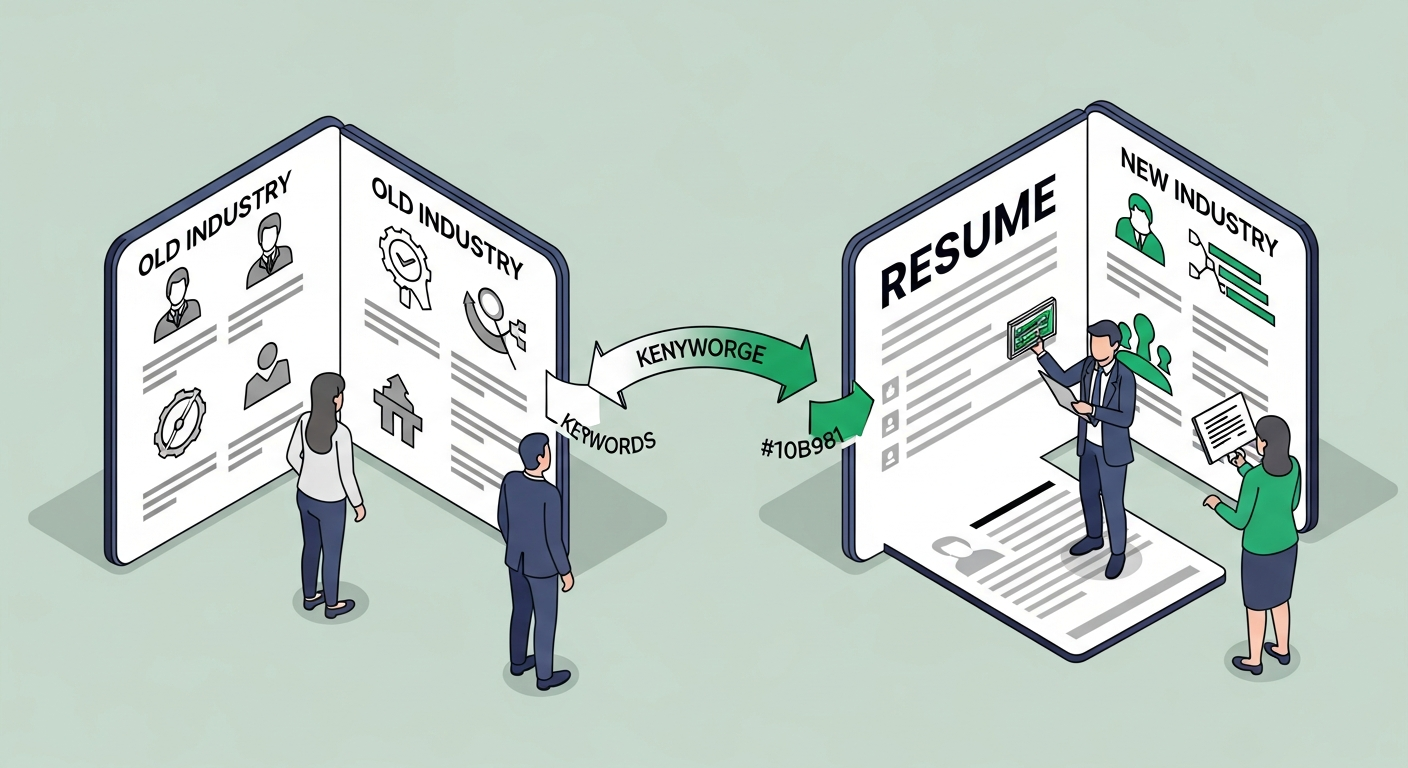
This is the specific problem a career change at 40 creates — not a qualification gap, but a translation gap. Your experience exists. Your skills are real. The document describing them is written in old-industry language, and ATS systems are keyword-matching engines, not comprehension engines. They cannot infer equivalence. They can only match text.
The work is not rewriting your career. It is translating what you have done into the vocabulary of where you want to go. Every section below is part of that translation.

Why ATS Systems Score Career-Change Resumes Lower
"Just apply to more jobs" is the most common advice career changers get, and it is wrong in a specific, measurable way.
ATS systems score your resume by comparing its text against the job description using keyword matching. The score is not a measure of qualification. It is a measure of vocabulary overlap — how many of the job description's key terms appear in your document, how often, and in which sections. Career changers start with lower overlap by definition, because their vocabulary comes from a different industry. Sending fifty applications with the same low-overlap document produces fifty low scores. The math does not improve with volume.
A recruiter at a 400-person company described her process publicly: she opens the system, sorts by score, and reads the top fifteen candidates. The threshold is roughly 65 out of 100. Anyone below that line is never opened — not because they are unqualified, but because the queue is too long to read further. She is not filtering candidates. The algorithm ranked them before she arrived at her desk. The recruiter is not your obstacle. The score is.
The 2021 Harvard Business School and Accenture study of eight million job postings found that 88% of executives acknowledged their ATS filtered out qualified candidates who should have advanced. Most had not changed anything, because manually reviewing 250 applications per posting was not operationally viable for their teams. The filter was doing exactly what it was built to do: reduce a pile to a manageable list. Accuracy was never the primary design goal. Speed was.
This is what applying to more jobs gets you when the underlying score is broken: a larger sample of the same result. The fix is to get the score above the threshold first, then scale applications. Fix the document. Then apply at volume.

Your Transferable Skills Are Invisible to ATS Unless You Translate Them
A project manager applied for a director-level role. The job description listed "stakeholder communication" as a required skill. Her resume said "cross-functional collaboration."
To any human reader, those phrases describe the same work. To the ATS scanning her document, "stakeholder communication" returned zero matches. She was filtered before the recruiter saw her name. She changed two phrases — using the job description's exact language. Got the interview. Got the job.
This is the mechanic career changers underestimate most. ATS systems do not score for meaning. They score for match. A synonym, even a perfect one, scores zero on most platforms. "Cross-functional collaboration" and "stakeholder communication" are not interchangeable to an algorithm built on exact-match keyword search. Neither are any of these:
- Retail "inventory shrinkage reduction" ≠ operations "loss prevention" or "inventory control"
- Teaching "curriculum design" ≠ L&D "training program development" or "instructional design"
- Journalism "editorial planning" ≠ content marketing "content strategy" or "content calendar management"
- Management consulting "workstream delivery" ≠ project management "project execution" or "milestone tracking"
Each pair describes identical work. The ATS cannot tell. And career changers carry more of these translation failures per resume than someone applying from within the target industry — which is why keyword tailoring is not a refinement for career changers. It is the primary intervention.
Some people resist using the job description's exact phrases because it feels like keyword stuffing. It is the opposite. Keyword stuffing means inserting terms you cannot support with real experience. Translating your vocabulary means replacing your accurate-but-unrecognized description with the industry's recognized description of the same work. The experience is unchanged. Only the label is different.
The fix is not to guess at the new industry's vocabulary. It is to read the job description carefully, extract every hard-skill term, and map each one against what you have actually done. Then use their phrasing, not yours. Every translation job runs both ways — yours just took a longer route to get here.

How to Translate Your Experience Into the New Industry's Language
Translation is a three-step process. First, extract every hard-skill keyword from the target job description — all of them, before you filter for what applies to you. Second, compare each keyword against your actual experience: where does the work match even when the vocabulary does not? Third, use the job description's exact phrasing in your resume — in the skills section, the summary, and the relevant work history bullets. Not your preferred description. Theirs.
Here is what that looks like across common career-change paths:
| Old-industry phrase | New-industry keyword |
|---|---|
| Cross-functional collaboration | Stakeholder management / stakeholder communication |
| Inventory shrinkage reduction | Loss prevention / inventory control |
| Curriculum design | Training program development / instructional design |
| Editorial calendar management | Content strategy / content calendar management |
| Shift scheduling | Workforce management / workforce optimization / labor planning |
| Client retention | Customer success / account management / churn reduction |
| Workstream delivery | Project execution / milestone tracking / PMO |
Build your own translation table from the specific job description you are targeting. If the posting says "KPI management," use "KPI management" in your skills section and at least one work history bullet. If it says "budget ownership" rather than "budget oversight," use their term. The precision matters to the ATS even when the distinction is invisible to a human reader.
Run your resume through ATSFixer's free gap analysis: paste your resume, add the job description, and see exactly which keywords are missing, which are present, and which are phrased incorrectly for ATS recognition. The average improvement after one adaptation is 31 points — which is typically the difference between sitting below the recruiter's 65/100 threshold and sitting above it.
The most common mistake at this stage is translating only the keyword names while leaving the supporting context in old-industry language. "Stakeholder communication" in your skills section helps. But "stakeholder communication" buried inside a bullet that still reads entirely as retail sends a mixed signal to the human reader. Translate the keyword and the context together. The ATS reads keywords. The recruiter reads context. Both have to work.
Free ATS Score Check
Your result looks like this —
get yours in 30 seconds.
Drag & drop your resume here
PDF or Word · max 10 MB
Results in under 30 seconds · no sign-up required

The Resume Format Career Changers Almost Always Get Wrong
Functional resumes seem logical for career changers. Group skills at the top, downplay the timeline, lead with what you can do rather than the sequence in which you did it. The logic is understandable. The ATS score is not.
Functional resumes parse badly on every major platform. Greenhouse, Workday, Taleo, and iCIMS all extract data by looking for a standard chronological structure — employer, title, date range, then bullets. When that structure is missing or reorganized, the parser either fails to extract your work history or produces garbled output that scores poorly. ATSFixer internal testing shows that 1 in 3 resumes submitted through Workday are corrupted during parsing due to non-standard layouts. Functional formats are a non-standard layout.
A TopResume survey found that 63% of recruiters say they reject resumes for formatting issues, not content. For career changers, that problem is harder to diagnose — the document looks fine to a human and essentially invisible to the machine at the same time.
What actually works for career changers on ATS platforms:
- Reverse-chronological format. Always, even when the career history feels awkward. The parser expects this structure and extracts it reliably. Use it.
- Summary section at the top. Two to three sentences naming the target role, the relevant transferable skills, and one concrete result. This is where career changers make their case to the human who eventually gets past the ATS gate.
- Dedicated skills section with new-industry keywords. List the hard-skill terms from the job description that you can honestly claim. ATS platforms weight the skills section separately from full-text search — a skill listed there scores twice, once as a structured field value and once in keyword density.
- Translated experience bullets. Your job titles stay as they were — you cannot retroactively change what your employer called your role — but the descriptions beneath them can be rewritten in the target industry's vocabulary.
The summary section is the most underused tool in a career-change resume. A functional format will score poorly and raise recruiter suspicion. A single-column reverse-chronological resume with a targeted three-sentence summary at the top lets the ATS pass you and lets the recruiter understand your pivot in the seven seconds they allocate to an initial scan. Both criteria matter. Use the format that satisfies both.

The Dates on Your Resume That Signal Age to ATS — and How to Fix Them
ATS platforms do not ask your age. They do not need to. Four common resume elements function as age proxies, and career changers making a mid-life pivot are more likely to have all four simultaneously than someone two years out of their first role.
Graduation year. A degree dated 1993 tells the parser and the recruiter everything they need to estimate your birth year. Most career advisers recommend removing the graduation year entirely — list the degree and institution, skip the date. The credential is relevant. The year it was awarded is not, unless you graduated recently enough that the date is still a positive signal.
Jobs from the 1990s or early 2000s. Listing work history starting in 1997 anchors your career to a different decade and adds job titles, software names, and industry terminology that no longer appear in current job descriptions. Trim your work history to the most recent 10–15 years. Anything older is unlikely to contain keywords the target job description is searching for — and the dates anchor you in a way that a strong skills section cannot fully undo.
Expired certifications. A PMP from 2004 that has not been renewed signals an old credential, not a current qualification. Remove certifications that have lapsed. If the credential matters to the target role, renew it before applying. A current certification date is a positive signal. An expired one signals that the certification stopped being a priority at some point.
Legacy software and outdated tools. Listing Microsoft Office 97, Lotus Notes, or WordPerfect adds nothing to your keyword match score and tells the recruiter something specific about when you last updated your technical baseline. Replace with current equivalents where relevant — Microsoft 365, Google Workspace, Slack, or whatever the target job description actually mentions. Cut any tool that does not appear in the job description and that you would not realistically use in the role.
None of these changes misrepresent your experience. They modernize how it is presented. A career change at 40 is a forward move. The resume should read like one.

When You Don't Need to Optimize for ATS
Most of this post assumes you are applying to companies that use applicant tracking systems. That assumption is wrong for a meaningful portion of career-change opportunities.
Companies with fewer than 50 employees often do not use an ATS at all. The application goes to a shared inbox or directly to the hiring manager. A heavily keyword-optimized resume written for Workday can read strangely to a human who is simply evaluating whether you seem like someone who can do good work. Over-engineering for keyword density at the expense of narrative clarity can hurt you with a small-company reader in a way it would not with a large-company algorithm.
The same logic applies when you are applying through a referral or warm contact. Seventy percent of roles are filled through networks before they are publicly posted. If someone inside the company is walking your resume to the hiring manager, the ATS gate is either bypassed or its threshold is substantially lowered. In that case, a clear, well-written document built for a human reader is more valuable than a high keyword score.
ATSFixer is built for keyword-optimized applications at companies that use Greenhouse, Workday, Taleo, iCIMS, or similar platforms. If you are a career changer at 40 with professional connections in the target industry, the highest-value first move is often to activate those contacts before you submit applications through job boards. Then use ATSFixer on the postings where you have no contact. The two strategies are not in competition — maintain two versions of your resume: one written for human readers at smaller companies, one optimized for ATS at larger ones. The difference is smaller than you would expect, but it is real.
Career changers who apply only through job boards and skip network outreach are optimizing for the hardest possible path. Build the ATS resume. Use it. And run network outreach in parallel. Both paths lead to the same place — one just has a machine standing at the gate.
The vocabulary problem that causes a 20-year career to score 22/100 on ATS is fixable in an afternoon. The translation is not glamorous work. It is not the kind of thing that comes up at networking events. But it is the difference between the algorithm surfacing your application and not — and at 40, your experience is genuinely an asset on the other side of that gate. You just need to learn the password. As it turns out, "stakeholder communication" is a very popular one.
Frequently Asked Questions
Related from ATSFixer
Frequently Asked Questions
40 is not too late — it is often an advantage. You bring 15–20 years of professional experience, established networks, and domain expertise that a candidate fresh out of school cannot replicate. The challenge is not your age; it is translating your experience into the new industry's vocabulary so ATS systems and recruiters can recognize what you are bringing.

Jordan Marcus
Senior Career Strategist
Jordan has reviewed 4,000+ resumes and coached candidates into roles at Google, Stripe, and McKinsey. She writes about the mechanics of ATS and what actually gets people interviews.