On this page
An optimal resume is not the one with the cleanest design, the most powerful verbs, or the most impressive company names in the header. It is the one that scores highest against a specific job description — before a recruiter opens the file.
Before a human reads your document, an applicant tracking system parses it, extracts structured data, and assigns a score. According to Jobscan's 2023 research, 75% of resumes are rejected by ATS before a human reads them. The algorithm runs first. "Optimal" means clearing that filter and then communicating clearly to the recruiter who looks at whatever's left. Most guides only teach one of those two skills — usually the one that happens second.
This guide covers both: the format that doesn't break parsers, the section structure that lets ATS extract the right data, and the keyword approach that pushes your score from a 40 to an 80. And yes, it also covers when none of this matters — because those cases exist, and ignoring them wastes everyone's time.

What an Optimal Resume Actually Means
The phrase "optimal resume" implies there is one correct answer — a single document you build once, file away, and send everywhere. That is not how it works. An optimal resume is optimal for a specific job description. The moment you apply to a different role, the target shifts.
That said, the underlying structure of an optimal resume is consistent. It solves for two readers in a specific order.
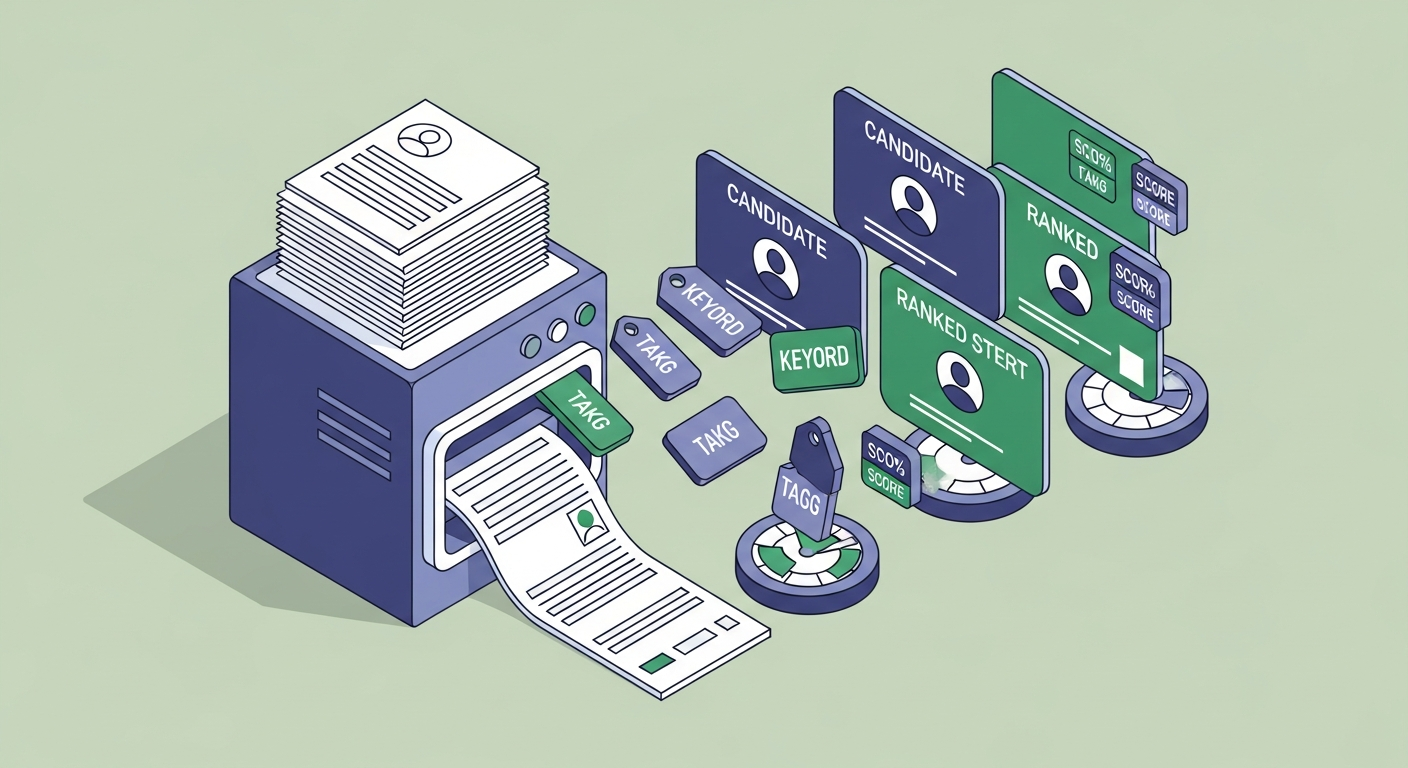
Reader one: the algorithm. An ATS parses your resume as raw text. It identifies fields — job titles, employers, dates, education, skills — and checks how many of the job description's required terms appear in your document. The match percentage becomes a score. That score determines whether reader two ever sees your file.
Reader two: the recruiter. A Ladders eye-tracking study found recruiters spend an average of 7.4 seconds on an initial resume scan. She's not reading. She's pattern-matching: job title, employer, dates, a few bullet points. If the structure is clean and the relevant content surfaces quickly, the file moves forward.
An optimal resume serves reader one by passing the filter. It serves reader two by being easy to scan the moment she opens it. Those two goals are more compatible than most people think — a clean, single-column, well-structured resume tends to score well with both.
The problem is that most "optimal resume" advice focuses entirely on reader two. Confident verbs, strong action words, quantified achievements — all useful for the recruiter, none of it relevant if you never get past the ATS. According to Jobscan, 98% of Fortune 500 companies use an ATS to screen candidates. The recruiter doesn't see the pile. She sees a sorted list. Your job is to be near the top of it.
(This is the part where most guides list 15 tips about fonts. I'll get to format. But the two-reader problem is the context that makes all of it make sense.)

The Format an Optimal Resume Uses Every Time
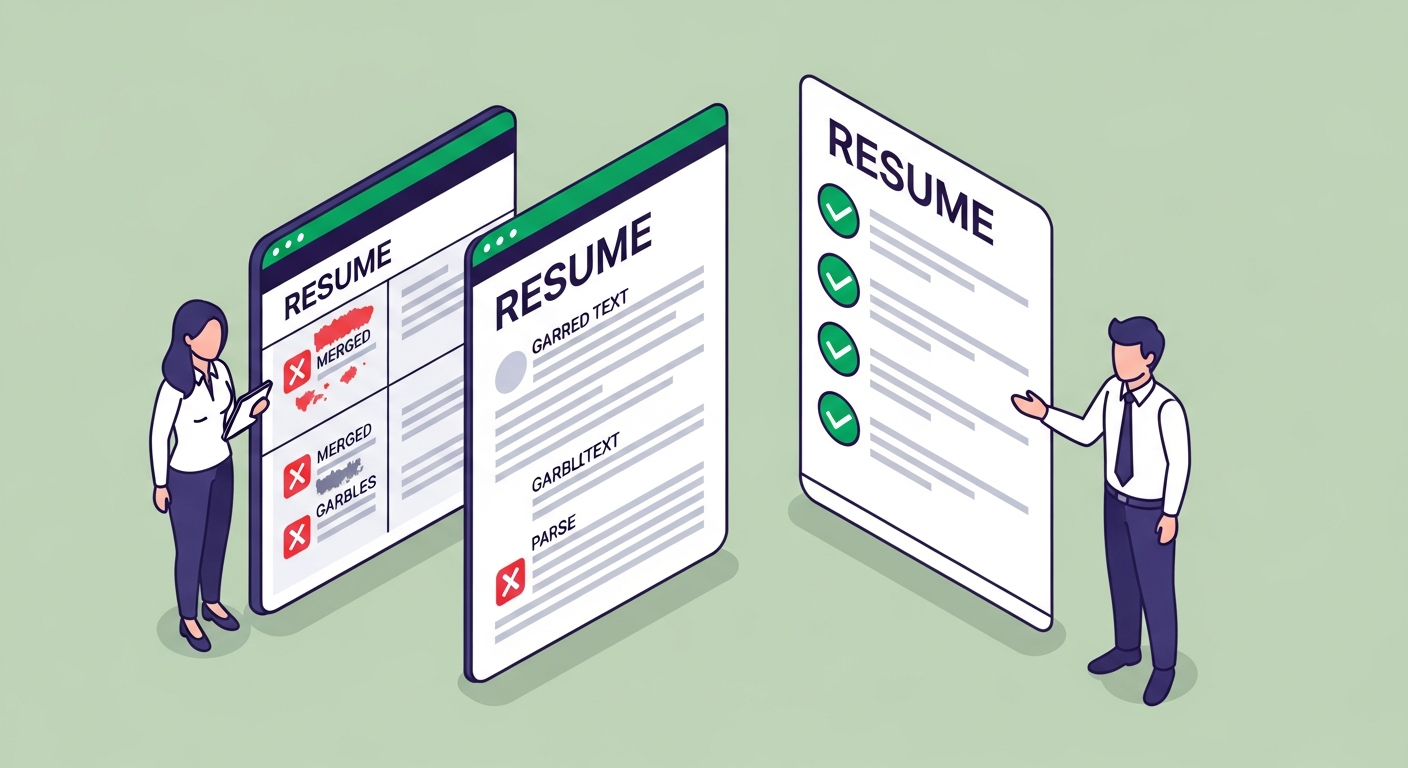
A software engineer with eight years of experience once came to ATSFixer with a beautifully designed two-column resume — skills in the left sidebar, work experience on the right. His ATS score: 12 out of 100. The parser had read both columns left-to-right in a single pass, merging his skills list with his job titles into garbled text. The system couldn't extract his employer names, titles, or dates. He looked, to the algorithm, like a blank page.
He converted to a single-column layout. Same content. No other changes. New score: 71 out of 100. Interview request that week.
The resume that wins three design awards tends to score 12/100. This is not a coincidence. Formatting choices that look impressive to a human — columns, sidebars, text boxes, decorative borders, custom fonts — are the same choices that break ATS parsers. The things that make a document look polished are often exactly what makes it unreadable to the algorithm.
What an optimal resume format looks like:
- Single column, top to bottom. No sidebars. No two-column layouts. No tables used for layout. In ATSFixer's internal testing, 1 in 3 resumes submitted through Workday are corrupted during parsing — most of them multi-column layouts.
- Standard fonts only. Arial, Calibri, Times New Roman, Georgia. 10–12pt for body text, 14–16pt for headings. The ATS doesn't care about fonts, but if your font renders as symbols on the recruiter's screen, the interview rate drops significantly.
- PDF or .docx. Modern ATS platforms — Greenhouse, Lever, Workday — handle both. The old advice to always submit .docx is outdated. A PDF is fine. An image-based PDF is not — if you can't highlight the text with your cursor, neither can the parser.
- Standard margins. 0.75 to 1 inch. Narrower margins sometimes clip content during parsing; wider margins waste keyword real estate.
- No headers or footers for contact info. Some parsers skip header and footer content entirely. Put your name, phone, email, and LinkedIn in the main body of the document.
- No graphics, logos, or photos. They don't parse. They just take up space and confuse the text extraction engine.
The test: copy all the text in your resume and paste it into a plain text editor. Read it top to bottom. If it reads in a logical order — name, contact, summary, experience, skills, education — the parser will likely read it the same way. If the text jumps around, the parser's reading is even worse.
63% of recruiters say they reject resumes due to formatting issues, not content, according to a TopResume survey. Format is the first filter, and it's entirely within your control.

The Section Order That Scores Higher
ATS parsers are trained to find resume sections in a predictable sequence. When sections appear in unexpected order or use non-standard labels, the parser either misclassifies the content or skips it entirely. A "Core Competencies" section may not register as Skills. A section called "Background" might not parse as Work Experience. A heading labeled "What I've Done" is optimistic.
The section order that scores consistently:
- Contact information — name, phone, email, LinkedIn URL, city and state (no full street address). No section header needed.
- Professional Summary — use this exact label or "Summary." This is where keyword density matters most: the summary is parsed as unstructured text and scanned for keyword matches. Put your top 4–6 job description keywords here.
- Work Experience — use "Work Experience" or "Professional Experience." Each entry needs employer, job title, dates (month/year format), and 3–5 bullet points with quantified results.
- Skills — use "Skills" or "Technical Skills." This is a dedicated structured field in most ATS platforms. Keywords listed here score twice — once as a skills field, once in the full-text search. It is the most under-used section on most resumes.
- Education — degree, institution, graduation year. For experienced candidates, this comes after work experience and skills. For entry-level candidates, it can lead.
- Optional sections — Certifications, Projects, Publications, Volunteer Experience. These come last and are most valuable when they contain keywords from the job description.
The section label matters. The skills section is genuinely the most underused part of a resume. It's where parsers extract structured keyword data. Most people either skip it entirely or fill it with "team player" and "detail-oriented" — which is the resume equivalent of showing up to a job interview and introducing yourself as "a person who is present." The algorithm ignores soft skills in skills sections. List the hard skills, tools, certifications, and platforms that match the job description's requirements.
One other section note: "References available upon request" takes up a line that could have a keyword. The recruiter knows. Skip it.
Free ATS Score Check
Your result looks like this —
get yours in 30 seconds.
Drag & drop your resume here
PDF or Word · max 10 MB
Results in under 30 seconds · no sign-up required

The Keyword Strategy That Separates Good from Optimal
A project manager applied for a role that listed "stakeholder communication" as a required skill. Her resume said "cross-functional collaboration" — which means the same thing to every human who has ever worked in an office, and to no ATS ever built. The system looked for "stakeholder communication," found zero matches, and scored her accordingly. She was filtered before the recruiter saw her name. She changed two phrases. Got the interview. Got the job.
ATS platforms do exact-match keyword scoring on most fields. Synonyms, even perfect ones, score zero. "Managed" and "oversaw" are not interchangeable to the algorithm. "Python" and "Python programming" may or may not match depending on the platform's configuration. The only safe approach is to mirror the job description's exact language.
The keyword strategy for an optimal resume:
- Extract the hard-skill terms. A typical job description contains 15–25 hard-skill terms according to Jobscan's 2022 analysis. Read the posting carefully and list every specific skill, tool, technology, certification, or methodology mentioned. These are your targets.
- Check each one against your resume. For every term that describes your actual experience, confirm it appears in your document using the job description's exact phrasing.
- Apply triple coverage for your top keywords. The most important terms should appear in your Summary, in your Skills section, and in at least one Work Experience bullet. Most ATS platforms weight frequency and placement — a keyword that appears once scores lower than one that appears three times in the right fields.
- Use exact phrases, not categories. "Data analysis tools" scores lower than "Excel, Tableau, Power BI." The more specific the term, the higher the match confidence. Job seekers who tailor their resume to each posting are 3× more likely to get an interview, per Jobscan's analysis of 1 million+ resume scans.
Yes, this means rewriting your summary and updating your skills section for each application. That's the actual work of a job search, and the median time it takes is 10–15 minutes per application. Ten tailored applications will produce more interviews than fifty generic ones. The math is not subtle.
The one guardrail: keyword stuffing — pasting the job description text in white at the bottom of your resume, or hiding it in the margins — gets detected and flagged. ATS platforms identify it. Don't.
For a deeper look at how to find and place keywords in a resume, see the guide on resume keywords and how to use them.

How to Build an Optimal Resume for Every Job
An optimal resume is not a document you finalize once. It is a framework you rebuild for each application. The structure stays fixed — single column, standard sections, standard labels. The content shifts to match the job description's vocabulary.
The workflow:
- Start with a base resume that has the correct format, section order, and section labels.
- Find a job description for a role you're applying to.
- Extract the top 10–15 hard-skill terms and requirements.
- Confirm each one appears in your base resume. If it describes your actual experience and it's missing, add it using the job description's exact phrasing.
- Update your Summary to lead with the job title and 3–4 of the highest-priority keywords.
- Review your Skills section and add any missing terms that reflect your real abilities.
- Score the updated resume against the job description before submitting. ATSFixer does this — you get an ATS score so you know where you stand before the application leaves your desk.
The average time to hire in the U.S. is 44 days, according to SHRM's 2023 data. That's 44 days from application to offer — which means a well-optimised application doesn't just increase your chance of an interview, it also determines how far into that 44-day window you enter the funnel. Getting in early matters.
When this doesn't apply: If you're applying to a company with fewer than 50 employees, it probably doesn't use an ATS. A direct referral to the hiring manager often bypasses ATS entirely regardless of company size. For those applications, a clean, honest resume written clearly for the human reader is the right tool — not a heavily keyword-stuffed document optimised for a parser that doesn't exist. We'll tell you when not to use ATSFixer. Small companies, direct referrals, and contract roles at boutique firms are often cases where the algorithm isn't in the room.
For more detail on resume format decisions and what breaks ATS parsing, the scannable resume guide covers the specific elements that cause parsing failures. For a complete breakdown of which sections belong on your resume and in what order, see the resume sections guide. And if you're not sure how the scoring actually works, how ATS systems work explains the ranking and filtering mechanics from the inside.
You've read an article about resume optimization all the way to the end. That level of thoroughness is exactly what it takes to get past an ATS. Now go update the skills section. The algorithm is waiting, and unlike your last recruiter, it will get back to you immediately.
Frequently Asked Questions
Related from ATSFixer
Frequently Asked Questions
An ATS-optimal resume uses a single-column layout, standard section labels (Summary, Work Experience, Skills, Education), exact-match keywords from the job description, and a parseable file type — PDF or .docx. The most important factors are keyword matching and format. A beautifully designed resume with columns or text boxes can score under 20 out of 100, while a plain single-column version with the right keywords scores 70+.

Jordan Marcus
Senior Career Strategist
Jordan has reviewed 4,000+ resumes and coached candidates into roles at Google, Stripe, and McKinsey. She writes about the mechanics of ATS and what actually gets people interviews.