On this page
- Why Your Questions Matter More Than Most Advice Tells You
- Questions to Ask About the Role Itself
- Questions to Ask About Your Manager and Team
- Questions to Ask About Performance and Growth
- Questions to Ask About Company Culture (That Get Honest Answers)
- The Questions Nobody Asks (and Why They Should)
- Questions to Avoid — and What to Ask Instead
- When This Advice Does Not Apply
- Frequently Asked Questions
Good questions to ask at an interview aren't optional — they're part of the evaluation.
Most people spend three hours rehearsing their answers and about four minutes thinking about what they'll ask. The result is predictable: "Do you have any questions for us?" answered with "Could you describe a typical day in this role?" — a question the job description already answered, which you'd know if you'd read it twice.
Here's the actual situation: by the time you're sitting in that room, everyone already knows your resume. Your questions are the only unrehearsed part of the conversation. They're the one signal that isn't scripted or pulled from a prep guide. A hiring manager can tell in seconds whether you came prepared or showed up hoping for the best. The 7.4-second number isn't rhetorical flourish — it comes from a Ladders eye-tracking study on initial resume scans. The instinct for spotting unpreparedness runs at roughly the same speed.
This post covers 20 good questions to ask at an interview, broken down by category, with an explanation of what each one reveals about the company. Plus the one category most job seekers skip entirely — and why those tend to be the most useful questions in the room.

Why Your Questions Matter More Than Most Advice Tells You
The average corporate job opening receives 250 applications. A recruiter at a 400-person company described her process publicly on LinkedIn: she opens Greenhouse, sorts by ATS score, reads the top 15. The cutoff is roughly 65/100. Anyone below that score is never opened — not because she decided they were unqualified, but because the list is too long to read past position 15. The algorithm sorted them before she arrived.
By the time you're in an interview, you've made it past that filter. The algorithm didn't pass you because it likes you — it passed you because your keywords matched. The feeling is not mutual. But the practical outcome is that you're one of roughly four candidates a recruiter thought was worth her time. Your competition went from 250 to four.
At that stage, skills and experience are roughly equal across the shortlist. What separates candidates is judgment, preparation, and fit — and your questions reveal all three simultaneously. A candidate who asks sharp questions leaves the room as a specific person with a specific point of view. A candidate who asks "what does success look like here?" leaves as a resume.
The deeper point: the job search isn't a lottery — it's a conversion funnel. Application → ATS pass → recruiter screen → hiring manager review → interview → offer. Most people optimize for the last two steps while spending no time on the first two, where 75% of candidates are eliminated. By the time you're in the interview, you've already won the hard part. Your questions are how you close it.
To understand exactly which part of your resume got you to the interview — and optimize the next one — run it through ATSFixer. The score shows you which keywords the algorithm found and which ones it ignored entirely.

Questions to Ask About the Role Itself
These are the questions interviewers expect — but most candidates ask weak versions of them. The difference between a good question and a useful one is specificity. "What does success look like?" is a weak question. "What would I need to accomplish in my first 90 days for you to consider this hire a success?" is the same question with a deadline attached. The deadline forces a concrete answer instead of a brochure answer. (If they can't answer it, that's also concrete — just in a different direction.)
Questions that work:
- What would I be working on in my first 30 days? This shows you're thinking about contribution, not just orientation. It also reveals how organized the onboarding process is. If they haven't thought about this, that's information worth having.
- What does success look like at 90 days and at 12 months? Ask for both. Short-term and long-term metrics together. If the two answers are inconsistent or one is vague, the role may not be well-defined yet.
- What are the biggest challenges someone stepping into this role would face? Interviewers who answer this honestly are worth working for. Interviewers who say "the challenge is keeping up with all the exciting opportunities" are telling you something different.
- What specific skills or experience gaps are you hoping this hire fills? This tells you what they actually need, versus what the job description says they need. Sometimes those are the same. Sometimes one was written 18 months ago and hasn't been updated.
- Has this role changed since it was first posted? Roles get rewritten as business needs shift. If the answer is yes, ask what changed and why. If it changed significantly, the original posting may be misleading you about the actual day-to-day.
Note the pattern: each question ends somewhere specific. That's intentional. Open-ended questions get you brochure answers. Specific questions get you something closer to the truth.

Questions to Ask About Your Manager and Team
The primary reason people leave jobs isn't the company — it's the manager. If you ask nothing else in this interview, ask something in this category.
The challenge is that generic questions get generic answers. "What's your management style?" almost always produces "I'm collaborative and supportive" regardless of reality. Every manager describes themselves as collaborative and supportive, in the same way that every resume lists "strong communicator" regardless of evidence. The trick is to ask for a behavior rather than a self-description.
Questions that work:
- How do you typically handle a situation where a direct report disagrees with a decision you've made? This is the management style question, rewritten to require an example. Pay attention to whether they describe a process or give you a vague principle. A manager who walks you through a specific scenario understands their own approach. A manager who gives you a general statement about "open communication" might not have one.
- How often would I interact with you week to week, and in what format? Structured check-ins versus ad-hoc conversations tell you how autonomous the role actually is. Both can be right answers. But knowing which one you're walking into matters.
- Can you tell me about the team I'd be working with most closely? Deliberately open. What they mention first tells you what's most salient about the team — skills, personalities, tenure, or recent changes.
- How long have most people on this team been here? A team with an average tenure of 18 months in a 10-year-old company is a signal. A team where most people have been there five years is a different signal. Neither is automatically bad, but both are informative.
If you're in a panel interview, direct the manager-specific questions at the person who would actually be your manager — not the HR coordinator running the logistics.

Questions to Ask About Performance and Growth
These questions matter most if you're planning to stay longer than 18 months. For short-term contract roles, adjust accordingly. But for permanent positions, the feedback and growth infrastructure tells you whether the company is invested in you as a professional or simply as a contractor with benefits.
Questions that work:
- What does the performance review process look like here? Once a year with no interim feedback is common and widely disliked. Ask specifically whether there are quarterly check-ins or ongoing feedback mechanisms beyond the annual cycle. According to SHRM, the average time-to-hire in the U.S. is 44 days — which means companies invest significantly in finding people. Ask whether they invest equivalently in keeping them.
- Can you describe the career path for someone in this role? The best version of this answer is a specific example: "the last two people in this role moved into X and Y positions." A vague answer about "lots of opportunities to grow" is the corporate equivalent of "we'll cross that bridge when we come to it."
- Does the company support professional development — courses, conferences, certifications? The answer tells you whether the company considers their employees' skills a corporate asset or a personal responsibility.
- What happened to the last person who held this role? The cleanest version of the growth question. If they were promoted, that's useful data. If they left for a competitor, that's a different kind of useful data. If the interviewer hesitates, that's data too.
Free ATS Score Check
Your result looks like this —
get yours in 30 seconds.
Drag & drop your resume here
PDF or Word · max 10 MB
Results in under 30 seconds · no sign-up required

Questions to Ask About Company Culture (That Get Honest Answers)
Culture questions are the hardest to ask well because every company claims a great culture. The values are on the website. The tagline is on the Glassdoor page. What you want isn't the official version — you want the unofficial one. The fix is to ask for evidence rather than description.
Questions that work:
- Can you tell me about a time the company handled a difficult situation in a way that reflected its values? A company with real values can answer this with a story. A company whose values are wall decorations will pivot to something abstract about "our commitment to transparency." The word "commitment" is where abstractions go to retire.
- What do you personally find most energizing about working here? Aimed at your interviewer, not the company. Authentic answers tend to be specific and slightly surprising. "The people" is not a specific answer. "The fact that we ship something every Tuesday and I can see the impact by Thursday" is.
- How does the company handle mistakes — can you give me a recent example? A cultural stress-test. Companies with psychologically safe cultures can answer this with a real story. Companies that run on blame-avoidance get uncomfortable and vague. Both responses are useful.
- What's one thing you'd change about the culture here if you could? The most honest cultural data you'll get in the entire interview. Most interviewers will give you something real. If they say "nothing," that's also an answer — just not a very credible one.
Listen for the pronoun split. A manager who describes company decisions as "they decided to..." is telling you something about their relationship to leadership. A manager who says "we made a call to..." is telling you something different. Small word. Large signal.
The Questions Nobody Asks (and Why They Should)
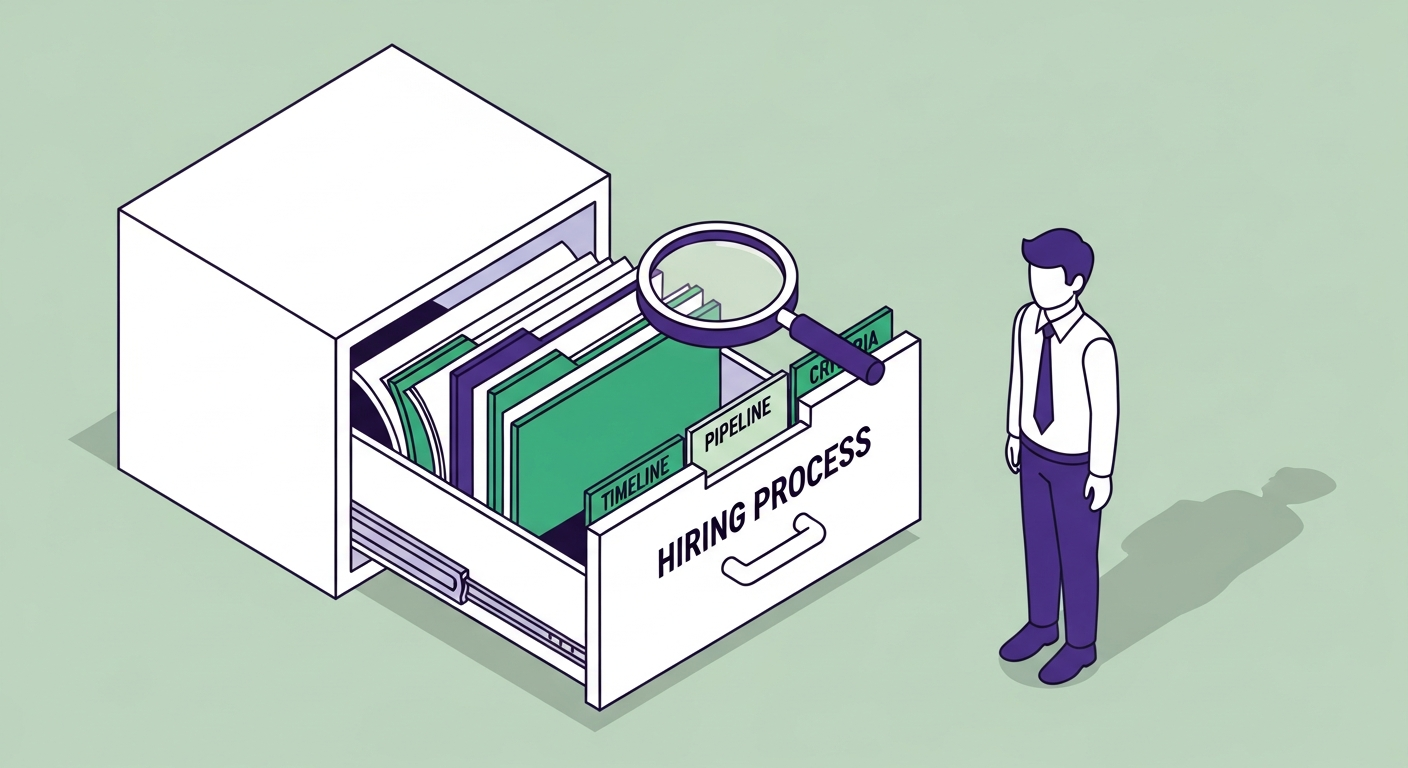
Here's the category that most interview prep guides skip entirely: questions about the hiring process itself.
By the time you're sitting in an interview, you've already been evaluated, scored, sorted, and selected from a pool of 250. Asking about the process that got you there isn't presumptuous — it's strategic. It reveals how the company thinks about talent acquisition, which is a reasonable proxy for how they think about talent generally. A company that runs a disorganized hiring process often runs other things the same way.
Questions in this category:
- How long has this position been open? A role that's been open for eight months isn't "hard to fill." It's a role where something is wrong with the brief, the expectations, the compensation, or the internal decision-making process. Any of those is worth knowing before you accept an offer.
- What does the rest of the interview process look like from here? The answer tells you whether the company is organized or improvising. A clear, structured answer is a good sign. "We'll be in touch" is a sign of something else.
- How did you find me — what made you decide to speak with me specifically? Useful if you applied through a job board and want to understand which part of your application created the signal. The answer sometimes reveals exactly which keywords or experiences caught the recruiter's attention. (I've reviewed enough resumes to know that candidates who understand which parts of their document are working tend to be significantly more strategic in subsequent applications — which is not a coincidence.)
- What's your timeline for making a decision? Not the same as "when will I hear back." This is asking about their internal process. An open-ended timeline on a role you actually want is a signal to follow up proactively.
These questions also signal something subtler: they tell the interviewer that you understand how hiring works. Most candidates experience the process as something that happens to them. Candidates who ask about the timeline, the pipeline, and the evaluation criteria signal that they've navigated it before and know what they're looking at. That reads as more senior regardless of career stage. Understanding how ATS systems work and how the process flows from screening to interview is exactly this kind of orientation — it shows up in the room even when you don't explicitly mention it.
Questions to Avoid — and What to Ask Instead
There are questions interviewers hear so often they've developed a calibrated internal wince. These are those questions.
Avoid these:
- "What does your company do?" If you don't know what the company does by the time you're in the interview, no question will fix that impression. Do the research before the call. Five minutes on their website, one read of their most recent announcement. That's the minimum.
- "What's the salary for this role?" (in a first-round interview) Legitimate question — wrong timing. The first interview isn't the place for it unless they've already raised it. Save it for when they've indicated they want to move forward. Asking it in round one isn't disqualifying, but it does signal that compensation is the lead factor in your evaluation.
- "How much vacation do I get?" Same logic as salary. Offer-stage question. In a first interview, these are the questions that tell the interviewer what you're most excited to negotiate — which is rarely the impression you want to lead with.
- "I don't really have any questions." This one is worth addressing directly because it genuinely happens. If you've worked through your list and they've actually answered everything, you don't have to manufacture questions. But saying "I don't have any questions" is a finish, not a landing. Say instead: "You've answered everything I'd prepared — the one thing I'd add is that I'm genuinely interested in [specific thing from the conversation]. Is there anything you'd want to know from me that we haven't covered?" That redirects to their needs and ends on a much better note than a shrug.

When This Advice Does Not Apply
Honestly: this structured approach is calibrated for mid-sized to large companies running formal hiring processes. A prepared list of eight questions doesn't fit every situation.
If you're interviewing at a company with under 20 people, the conversation is probably less formal. The founder or hiring manager is looking for someone who fits the team and can contribute quickly — not someone who arrived with a structured inquiry framework. In those settings, organic curiosity and genuine back-and-forth tend to land better than a prepared inventory of questions about the feedback cycle. Read the room. If the interview started with "so, tell me about yourself and what you do for fun," it probably won't end with a 30/60/90-day plan discussion.
For companies that don't use an applicant tracking system — most companies under 50 people don't — the calculus shifts. Your resume is going directly to a human reader, not a parser. In those cases, the things that make you a compelling person matter more than keyword density, and your interview questions should reflect that you understand the difference. That's the one situation where telling people not to use ATSFixer is the right call. The resume improvement tips that matter for small-company applications are different from the ones that matter for Fortune 500 hiring pipelines.
And if you're transitioning industries or applying for a creative role where the hiring process itself is unstructured, the interview may be a conversation rather than an evaluation. In those environments, prepared questions can feel out of place. Bring a few, use them lightly, and prioritize listening. The best interviews in that context often feel like collaboration rather than assessment — and a list of eight pre-prepared questions can accidentally close that door.
For everything else: prepare the questions, bring them written down, and use the ones that haven't already been answered. Making your resume stand out is what gets you into the room. Your questions are what make you memorable when you leave it.
Frequently Asked Questions
Related from ATSFixer
Frequently Asked Questions
Prepare 6–8 questions, but plan to ask 3–4. You rarely have time for all of them, and asking fewer questions with genuine follow-up reads better than rushing through a list. Always ask at least two — one about the role or expectations, and one about what the next steps look like.

Jordan Marcus
Senior Career Strategist
Jordan has reviewed 4,000+ resumes and coached candidates into roles at Google, Stripe, and McKinsey. She writes about the mechanics of ATS and what actually gets people interviews.