On this page
- What Healthcare ATS Systems Do With a Nursing Resume
- How to Format a Nursing Resume ATS Can Actually Read
- The Sections a Nursing Resume Must Have — in Order
- Nursing Resume Keywords That Score — and the Ones That Score Zero
- How to Write a Nursing Resume Summary
- New Grad Nurse Resume vs. Experienced RN Resume
- When You Don't Need to Optimize for ATS
A nursing resume gets evaluated twice. First by a hospital ATS that doesn't care about your bedside manner. Then by a recruiter who has roughly 7.4 seconds to decide whether to open your file. Most nursing resumes don't survive the first read.
The reason isn't qualifications. A 2021 Harvard Business School and Accenture study of 8 million job postings found that 88% of executives acknowledged their ATS filters out qualified candidates who should have moved forward. Nurses aren't exempt. Large hospital systems route every application through Workday, Taleo, or iCIMS before a recruiter touches the stack — and those systems score your document against the job description's keywords, not your clinical judgment.
The algorithm is predictable. It's looking for specific things in specific places, and once you know what those are, a nursing resume isn't difficult to get right. The most common mistake, for the record, is listing "compassionate" in the skills section. It's on roughly 90% of nursing resumes. The algorithm treats it the same way a recruiter treats "works well in a team" — as background noise that scores nothing.
This guide covers format, section structure, keyword strategy, and the honest exceptions — including when you don't need to optimize for ATS at all.

What Healthcare ATS Systems Do With a Nursing Resume
Hospital hiring is high-volume. A large health system posting an ICU RN position can receive 200+ applications in a week. A travel nursing agency processing requests across multiple facilities can see that number before Friday. No recruiter reads all of them first. The applications go into an ATS, which parses each resume, extracts structured data, and scores it against the job description's required terms.
That score determines whether a recruiter opens your file. At many organizations, the recruiter sorts by score and reads the top 10 to 20. The cutoff isn't a deliberate decision — it's a queue management problem. There are 200 applications and one recruiter. The algorithm sorted them before she arrived, and she starts at the top.
A recruiter at a 400-person health system described her exact process in a LinkedIn post: she opens the ATS, sorts by score, reads the top 15. The cutoff is roughly 65 out of 100. Anyone below that score is never opened — not because she decided they were unqualified, but because the list was too long to read past position 15. The algorithm didn't pick the best nurse. It picked the highest-scoring documents. Those are not always the same nurses.
The specific ATS platforms vary across healthcare. Workday dominates large hospital systems and health networks — it's used by 45%+ of Fortune 500 companies, and healthcare is no exception. Taleo (Oracle) runs at established hospital systems with legacy infrastructure, government health agencies, and large insurers. iCIMS is common in healthcare and manufacturing. Travel nursing agencies often run their own ATS portals. Smaller clinical practices may use Greenhouse or nothing at all.
What they all share: they parse your resume as raw text, extract structured fields (name, contact, job titles, dates, education, skills), and score keyword matches. The parser doesn't see your resume the way a recruiter does. It sees characters, and it confirms whether those characters match the terms in the job posting.
According to Jobscan's 2023 research, 75% of resumes are rejected by ATS before a human reads them. Nursing applications go through the same filter. Healthcare isn't a special case — it's just a high-volume sector where the filter runs especially hard.
For a fuller explanation of how ATS ranking and scoring works across industries, see our guide on how ATS systems filter and rank candidates.

How to Format a Nursing Resume ATS Can Actually Read
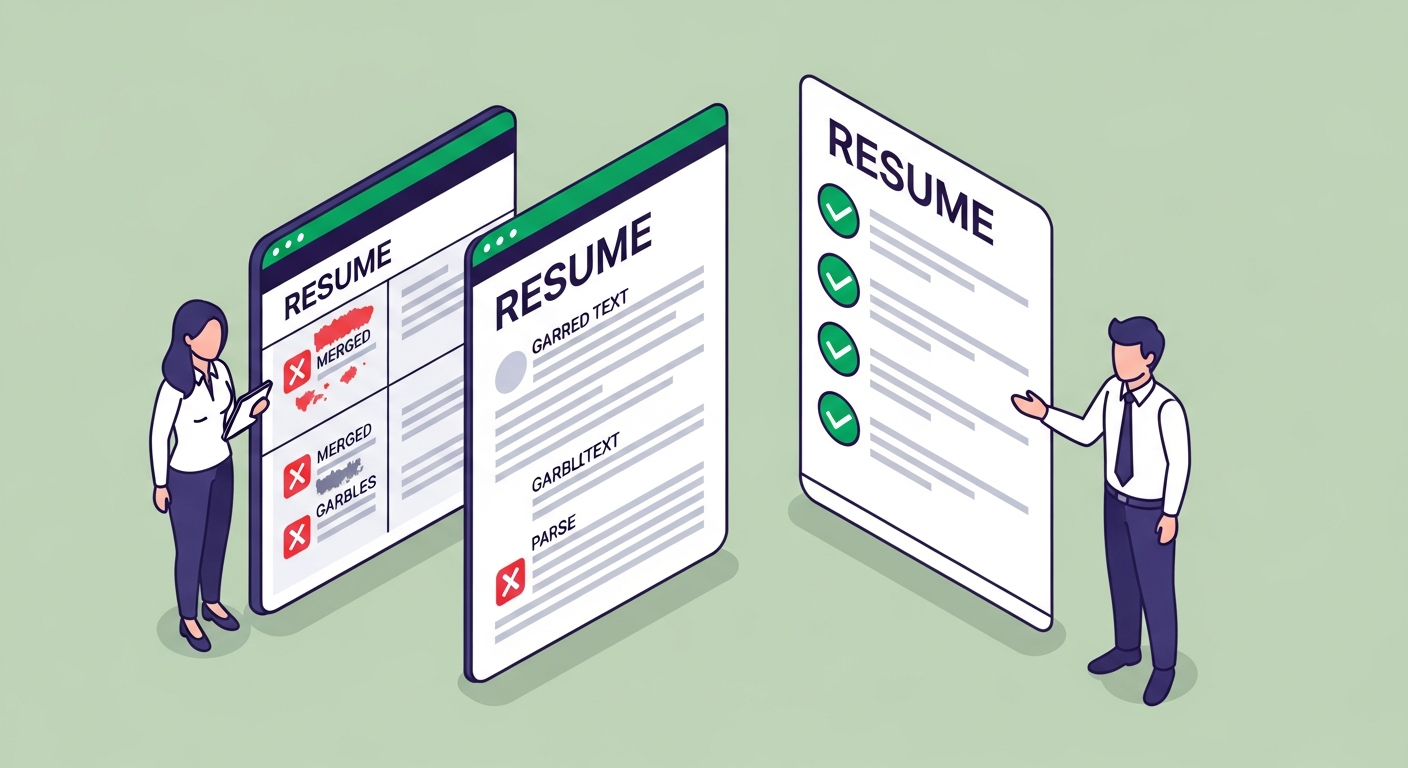
The format problem in nursing resumes is specific. Nursing schools and clinical programs sometimes distribute resume templates that look professional, print beautifully, and break every major ATS parser. Two columns. A left sidebar listing certifications and skills. Decorative borders or nursing-themed header graphics. A table for credential details.
Every one of those elements causes parsing failures.
A software engineer with 8 years of experience once submitted a two-column resume — skills in the left sidebar, experience on the right. His ATS score: 12 out of 100. The parser read both columns left-to-right in a single pass, merging the skills list with the job titles into garbled text. The system couldn't extract his employer names, titles, or dates. He looked, to the algorithm, like a blank page. He converted to single-column. Same content, no other changes. New score: 71 out of 100. Interview request that week.
Nursing resumes using the same two-column layout produce the same result — only now the parser is also failing to read the certifications section, which in a nursing application is the most critical field both the ATS and the recruiter need to verify.
What breaks ATS parsing on nursing resumes:
- Two-column layouts and sidebars. Parsers read left-to-right in a single pass. Skills merge into job titles. Certifications become part of the work history. In ATSFixer's internal testing, 1 in 3 resumes submitted through Workday are corrupted during parsing — and most are multi-column layouts.
- Tables and text boxes. Content inside tables or text boxes is often completely invisible to ATS parsers. Many nursing resume templates put credential grids in tables. The system may not extract those certifications at all, meaning you score zero on the most important requirement the recruiter is checking.
- Creative section labels. "Clinical Background," "Healthcare History," "My Nursing Journey," "Professional Highlights" — these make sense to a human reader and confuse parsers expecting "Experience," "Skills," "Education," and "Certifications." Use standard labels. This is not a stylistic preference. The algorithm is not good at creative naming conventions, and I mean that literally.
- Icons and decorative elements. Stethoscope icons next to your name, nursing-themed borders, colored section dividers — these produce unreadable characters in parsed output. No graphics, no icons, no decorative anything.
- Contact information in document headers or footers. Some parsers skip header and footer content entirely. Put your name, phone, email, and location in the main body of the document, not in a formatted header block.
- Image-based PDFs. If you can't highlight the text in your PDF with your cursor, neither can the parser. An image-based PDF scores zero. This applies to scanned copies of older resumes and to certain PDF exports from design tools.
The format that works: single-column layout, standard fonts (Calibri, Arial, or Times New Roman at 11–12pt), standard section labels, and a PDF converted from a clean .docx file. When given a format choice in an online application portal, choose .docx — Word files parse more reliably across Workday, Taleo, and iCIMS than PDFs do.

The Sections a Nursing Resume Must Have — in Order
Section labels matter more than section order. ATS systems parse your resume by recognizing standard header text. "Work History" works. "My Journey in Nursing" does not. The algorithm is a pattern-matching system that expects a fixed vocabulary of section labels, and anything outside that vocabulary gets misclassified or ignored.
1. Contact information
Name with credentials (RN, BSN, CCRN, etc.), phone, professional email, and city and state. No photo. No full street address. LinkedIn profile if it's been updated within the past year. Credentials after your name aren't decorative — the ATS often parses them as part of the candidate classification field.
2. Professional summary
Three to four lines. Your specialty, years of experience, two or three specific clinical competencies that mirror the job posting, and one quantified detail or notable certification. Not "experienced RN seeking a rewarding opportunity in patient care" — that string scores zero and tells the recruiter nothing she couldn't infer from the fact that you submitted a nursing resume.
3. Licenses & Certifications
Use "Licenses & Certifications" or "Licensure" as the section header — not "Professional Credentials" or "Qualifications" or anything creative. This is where most nursing resumes fail, and the failure usually takes one of three forms: the section is mislabeled, the license number is buried in the contact block, or certifications are listed without expiration dates.
- RN license number and expiration date, state of licensure
- NCLEX pass date if you're a new grad (some systems verify this independently)
- BLS, ACLS, PALS, NRP — with expiration dates for each
- Specialty certifications: CCRN, CEN, CNOR, CNRN, CPAN, and others — with official names and dates
Healthcare recruiters verify credentials before scheduling an interview. A missing license number creates a delay that costs candidates offers — not because they lacked the credential, but because the delay allowed another candidate to move forward. Put the number in the resume, in the right section, with the right label.
For a deeper look at how section order and labels affect ATS scoring across all resume types, see our guide on which resume sections confuse ATS parsers.
4. Work experience
Reverse-chronological. For each role: facility name and type (academic medical center, community hospital, long-term care, home health), department or unit, dates, and three to six bullet points. Start bullets with action verbs. Quantify where you can: "Managed care for 6–8 MICU patients per 12-hour shift" outperforms "Provided critical care nursing" on both the ATS score and the recruiter's read.
5. Education
Degree, institution, graduation year. New grads within three years of graduating should list education before experience — it's typically the strongest credential at that stage, and parsers weight what appears first more heavily in some systems.
6. Skills
A dedicated skills section scores twice on most ATS platforms: once as a structured extracted field, once in the full-text keyword search. Many nurses skip this section or fill it with soft skills. The next section explains exactly why that is a problem.
Free ATS Score Check
Your result looks like this —
get yours in 30 seconds.
Drag & drop your resume here
PDF or Word · max 10 MB
Results in under 30 seconds · no sign-up required
Nursing Resume Keywords That Score — and the Ones That Score Zero
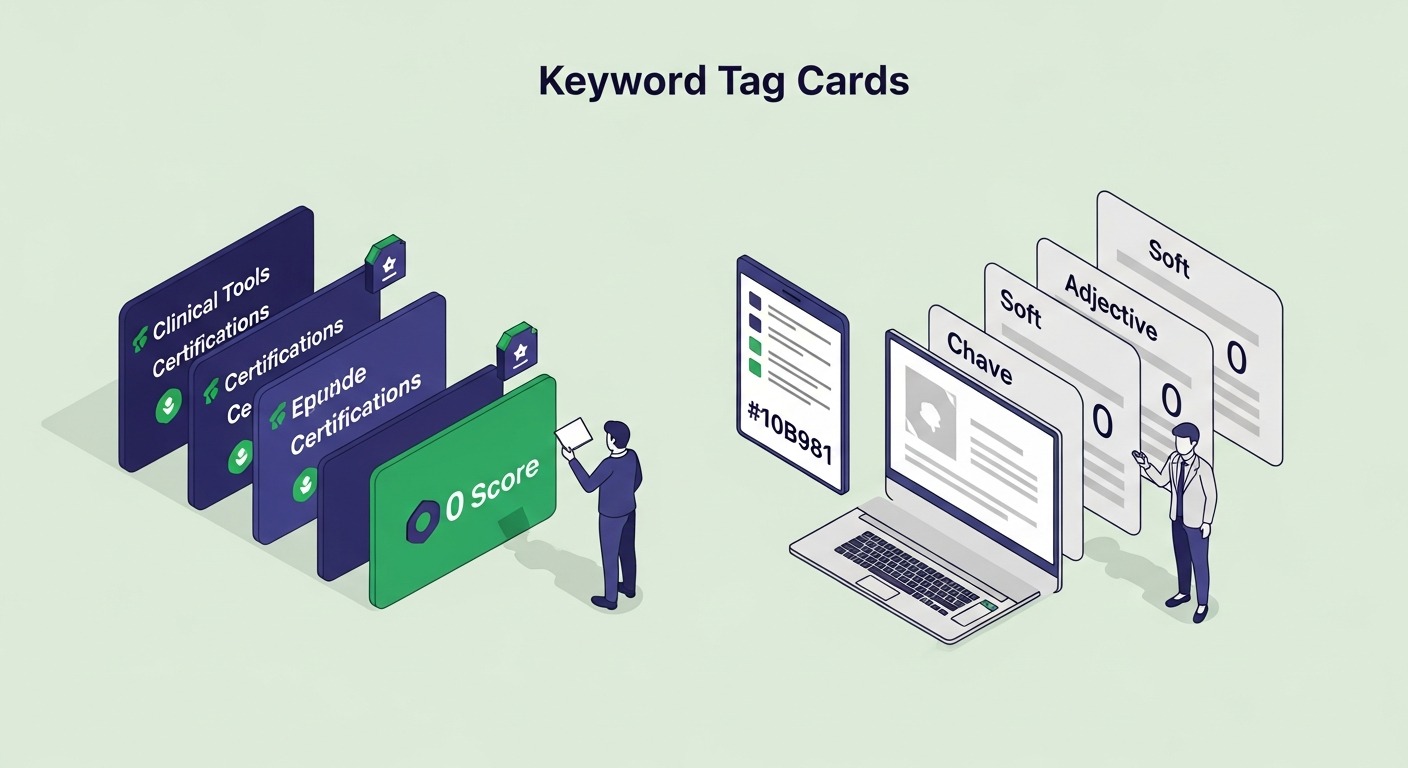
Here is the opinion worth saying directly: soft skills in a nursing resume skills section score nothing on ATS keyword matching.
"Compassionate." "Empathetic." "Patient-centered." "Dedicated healthcare professional." "Team player." "Strong communicator." These phrases appear on roughly 90% of nursing resumes. This puts them in the same category as "detail-oriented" and "results-driven" — terms so universal the parser has effectively tuned them out. The algorithm doesn't score them because nursing job descriptions don't list them as requirements. No recruiter is posting a role that says "Required: compassionate."
Prove those qualities in your experience bullets. "Maintained a 4.8/5 patient satisfaction score across 18 months in a 32-bed med-surg unit" demonstrates patient-centered care. "Compassionate" doesn't demonstrate anything.
Keywords that score on hospital ATS:
- EHR platforms: Epic, Cerner, Meditech, Allscripts, CPOE, PointClickCare
- Certifications: BLS, ACLS, PALS, NRP, CCRN, CEN, CNOR, CNRN, CPAN
- Clinical skills: IV therapy, medication administration, phlebotomy, wound care, catheterization, ventilator management, trach care, chest tube management, hemodynamic monitoring
- Patient care processes: patient assessment, care planning, patient education, discharge planning, infection control, fall prevention protocol, medication reconciliation
- Specialty unit terms: ICU, MICU, SICU, NICU, PICU, CCU, ED, ER, OR, PACU, L&D, telemetry, med-surg, oncology, labor and delivery
- Compliance and safety: HIPAA, Joint Commission standards, rapid response, restraint documentation
Keywords that score zero (or near zero):
- "Compassionate," "empathetic," "caring," "dedicated," "passionate"
- "Strong communication skills," "team player," "hardworking"
- "Patient-focused," "patient-centered care" (the generic version — specific documented outcomes score; the phrase alone doesn't)
- "Detail-oriented," "organized," "reliable"
The second critical issue is exact matching. A nurse who writes "medication management" instead of "medication administration" — the exact phrase in the job description — scores zero on that keyword. "Patient records" instead of "EHR documentation" scores zero. "Acute care experience" instead of "critical care" might score zero if the posting uses a specific term.
This is the synonyms problem that affects every resume, but it's especially sharp in nursing because clinical terminology has many acceptable variations in conversation and almost no flexibility in ATS scoring. A project manager who listed "cross-functional collaboration" on her resume instead of "stakeholder communication" — the exact phrase in the job description — was filtered before the recruiter saw her name. Changed two phrases. Got the interview. Got the job. Nursing has the same dynamic, applied to clinical terms instead of corporate ones.
Mirror the job description's exact phrasing. Pull the required skills list, copy the relevant terms, and use the same words in the same form. Not close. Exactly.
Job seekers who tailor their resume to each specific application are 3× more likely to get an interview, according to Jobscan's analysis of more than one million resume scans. For nurses applying to multiple facilities — which is most nurses — that means updating the skills section and summary for each posting before you submit.
For a full breakdown of how keyword placement and density affect ATS scores, see our guide on resume keywords: how to find and use them. For building a skills section that actually scores, see how to build your skills section for ATS.

How to Write a Nursing Resume Summary
The nursing resume summary is the part almost every candidate writes last, under time pressure, after spending 45 minutes on the experience section. Which explains why so many of them read like this: "Dedicated and compassionate RN with a passion for patient care seeking a fulfilling opportunity in a supportive and collaborative healthcare environment."
That sentence scores zero on ATS keyword matching and tells a recruiter nothing she couldn't infer from the fact that you submitted a nursing resume. It's also — and I say this with professional respect — the same sentence on the resume ahead of yours and the three after it.
A strong nursing resume summary has three components:
- Your role title, specialty, and experience level — specific enough to parse as a classification field
- Two or three clinical competencies that match the target posting's requirements exactly
- One quantified detail or notable certification that differentiates
Example for an experienced ICU RN:
"Critical care RN with 7 years of experience in MICU and SICU settings. CCRN-certified. Skilled in ventilator management, hemodynamic monitoring, and CRRT. Led a unit-wide bundle protocol that reduced central line-associated bloodstream infections by 23% over 12 months."
Example for a new graduate:
"BSN graduate (May 2026, NCLEX-RN passed June 2026) with 600+ clinical hours across med-surg, pediatric, and ED rotations. BLS and ACLS certified. Proficient in Epic EHR. Seeking RN position in acute care or emergency settings."
Start with your job title — "Critical Care RN" or "New Graduate BSN" or "NICU RN" — because the parser uses that as a classification signal. A summary that starts with "Seeking" or "Dedicated" makes the algorithm work harder and doesn't benefit you.
Keep it to three to four lines. If you can't describe your nursing background in four focused lines, the summary is probably trying to do too much.

New Grad Nurse Resume vs. Experienced RN Resume
The structure is the same. The emphasis is different.
New graduate nurses (within two years of NCLEX pass):
Lead with education. Your BSN is your primary credential at this stage, and it belongs above the experience section — parsers in many ATS systems weight the fields that appear first, and your degree is the qualification that matters most when paid experience is limited.
Clinical rotations belong in a section labeled "Clinical Experience" — not "Work Experience," which implies paid employment you may not yet have. For each rotation: facility name and type, unit, date range, and three to four specific bullets using clinical language. Quantify hours where you can: "500+ clinical hours across two hospital systems, including med-surg and NICU rotations."
NCLEX pass date and provisional license status belong in the Licenses & Certifications section — not in the contact block, not mentioned once in the summary. That's where healthcare recruiters and credential verification processes expect to find it, and that's where the ATS extracts it as a structured field.
Write your summary starting with "New Graduate BSN" or "NCLEX-RN (passed [month, year])" — not "Aspiring nurse." You passed the boards. You're not aspiring to anything. The credential is real.
Experienced RNs (three or more years of paid clinical work):
Lead with experience. Section order: Professional Summary → Licenses & Certifications → Work Experience → Skills → Education. Your degree is a credential; your clinical career is a qualification. Put what the ATS and the recruiter care most about first.
Update the skills section and summary for each application. A med-surg RN applying to an ICU position and a travel nursing contract on the same day should not submit the same resume. The keyword requirements differ materially, and a tailored resume is 3× more likely to produce an interview. Updating keywords takes 15 minutes per application. Sending the same document 50 times and getting zero callbacks takes much longer. (The math here is not subtle.)
Travel nurses: List each contract under a "Travel Nursing" header with staffing agency, facility name, unit, and contract dates. Rapid employment changes can trigger ATS instability flags. A clearly labeled section removes the flag — the pattern reads as intentional, not erratic.
Specialty certifications belong in the Licenses & Certifications section with expiration dates, not only mentioned in the summary. The ATS scores the dedicated section and the summary separately; a certification mentioned only in passing may not extract correctly as a structured credential field.

When You Don't Need to Optimize for ATS
Not every nursing job application goes through an ATS, and being direct about the exceptions matters more than pretending the optimization always applies.
If you're applying to a small private medical practice, a solo-physician clinic, a community health center with fewer than 50 staff, a school nurse position, or a home health agency that doesn't use a structured application portal — the probability of ATS involvement is low. Most organizations under 50 employees don't use Workday or Taleo. The application goes to a hiring manager's inbox and a human reads the document. Optimizing for a filter that doesn't exist is wasted effort.
Tell someone when not to use ATSFixer, too. If you're applying to a small rural clinic where the office manager is reading every resume directly, keyword density matters less than clarity and credibility. Write a clean, specific, readable document. Don't reverse-engineer a machine that isn't in the room.
The ATS optimization matters at hospital systems, large health networks, multi-facility health organizations, travel nursing agencies (which run internal ATS portals to process high applicant volume before a recruiter calls), and any facility using an online application portal with a login and a status tracker. That describes the majority of hospital-based nursing jobs. But not every nursing role is hospital-based, and some of the best positions are at organizations where a human reads your document on day one.
If you're unsure, paste your resume and the job description into ATSFixer's free score tool before submitting. It'll show you whether the keywords are matching and where the score is losing points. That's more useful than guessing, and it takes about 30 seconds.
If you've made it through an article about ATS keyword scoring while actively job searching, you have the patience of a night shift nurse. The algorithm, at least, doesn't ask you to explain the same thing to three different people who didn't read the notes. (Recruiter phone screens are a different story, but that's a different article.)
Related from ATSFixer
Frequently Asked Questions
A nursing resume should use a single-column layout with standard section labels: Professional Summary, Licenses & Certifications, Work Experience, Education, and Skills. No sidebars, no tables, no graphics, no decorative elements. Font should be Calibri, Arial, or Times New Roman at 11–12pt. Submit as a PDF converted from a .docx file — this combination passes every major ATS parser used in healthcare hiring and reads cleanly to a recruiter.

Jordan Marcus
Senior Career Strategist
Jordan has reviewed 4,000+ resumes and coached candidates into roles at Google, Stripe, and McKinsey. She writes about the mechanics of ATS and what actually gets people interviews.