On this page
A single page resume is the right move for roughly half the job seekers I talk to. For the other half, it's quietly costing them interviews — not because it's too short, but because fitting everything onto one page means cutting bullet points, and bullet points are where keywords live.
The one-page rule is older than Greenhouse, Lever, and Workday combined. It came from a world where recruiters physically held your resume and sorted through a pile of 250 on a Tuesday morning. That world still exists at a few companies, but at 98% of Fortune 500 employers, the first reader is an algorithm — and algorithms don't count pages. They count keyword matches.
The real question isn't whether your resume is one page or two. It's whether it contains enough exact-match keywords to pass the ATS filter before a human ever sees it. Once you understand that, the single page decision mostly answers itself.

What the Single Page Resume Rule Was Actually For
The one-page rule became career gospel sometime in the 1970s, when resumes were typed on paper, printed, and handed to a human who read them all the way through. In that context, one page was genuinely good advice: it forced you to edit ruthlessly, respected the reader's time, and prevented the kind of resume inflation that happens when there's no constraint at all.
Then companies started receiving 250 applications per job opening. Humans stopped reading resumes all the way through. And then applicant tracking systems arrived — and the first reader became an algorithm that doesn't read your resume at all. It parses it.
ATS platforms like Greenhouse, Workday, Taleo, and iCIMS extract your job titles, dates, skills, and keywords into structured fields. They don't experience your resume as a document with pages. They process it as a stream of text. Whether that stream comes from one page or three is irrelevant to the system. What isn't irrelevant: whether that stream contains the exact phrases it's looking for.
According to Jobscan's research, the average job description contains 15–25 hard-skill terms. Every time your resume contains an exact match for one of those terms — not a synonym, not a paraphrase, the exact phrase — your ATS score goes up. Miss enough matches and you're filtered before a recruiter opens your file.
The 7.4-second scan time — how long a Ladders eye-tracking study found recruiters spend on an initial resume review — is real, but it applies to the human reader who sees your resume only after you've cleared the ATS. Page count affects neither step.
So why does the one-page rule persist? Because it's still useful advice for people who'd otherwise pad a thin resume with irrelevant filler. And because career advice, once accepted, tends to stay accepted regardless of whether the conditions that made it useful have changed. (See also: the objective statement, "references available upon request," and sending your resume as a Word doc.)
When a Single Page Resume Is the Right Call
If you have fewer than three to four years of full-time work experience, one page is the right format. Not because of tradition, but because a two-page resume with limited history signals padding — and recruiters clock this faster than they'd let on.
Entry-level and early-career candidates. One page forces useful discipline. You don't have 15 years of bullets to draw from; you have a few roles, some projects, and a skills section. One page is enough — and it compels you to make every line earn its space. Every bullet should either contain a keyword from the job description or demonstrate a measurable outcome. If it does neither, cut it and stop grieving the space.
Career changers trimming irrelevant history. If you spent a decade in a field you're actively leaving, that old experience probably doesn't contain the keywords the new field needs. A one-page resume focused entirely on transferable skills, recent training, and adjacent work is often stronger than a two-pager that splits recruiter attention between who you used to be and who you're applying as now.
Applications to small companies that don't use ATS. If you're applying to a 15-person company where the founder reads every resume personally, you're writing for a human reader first. Clarity and concision matter more than keyword density. One page is a good signal. (This is the situation where ATS optimisation matters less than an honest, direct document — and we'll say that plainly.)
A 2026 survey found that 68.6% of recruiters prefer two-page resumes when given the choice. That's a clear majority. But that data describes what experienced professionals should send. It's not a mandate for every job seeker. If you have three years of experience and send two pages, you're almost certainly padding — and the recruiter will know.
The Keyword Cost Nobody Talks About
This is the part most single page resume guides skip entirely.
When you compress your resume to fit on one page, you cut content. That content is almost always bullet points from your work experience sections — because bullets take the most space. And bullet points are where ATS systems look for keyword evidence.
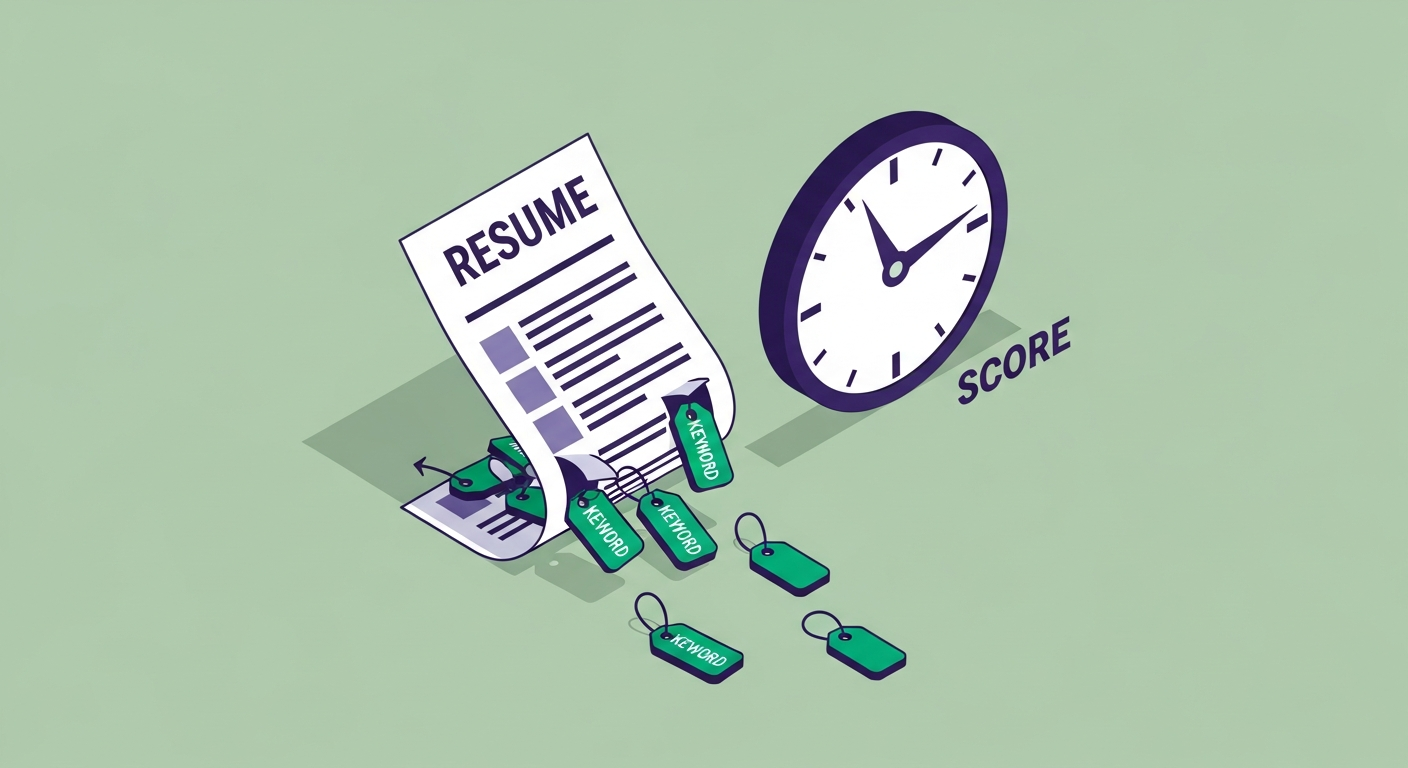
Here's the mechanism: ATS platforms don't just scan your skills section. They scan your entire document. Most platforms weight keywords higher when they appear in multiple places — once in your skills section and again in your work experience bullets. A keyword appearing in both locations scores better than a keyword in only one. Cut three bullets to meet a page constraint, and you may be cutting three keyword match opportunities without realising it.
There's a specific version of this that costs people interviews. A project manager applied for a role that listed "stakeholder communication" as a required skill. Her resume said "cross-functional collaboration" — which means the same thing to a human, and to no ATS ever built. The system looked for "stakeholder communication," found zero exact matches, and scored her accordingly. She was filtered before the recruiter saw her name.
She changed two phrases in her experience bullets. Got the interview. Got the job.
The lesson isn't only "use exact keywords." The lesson is: keywords live in your bullets. If you're cutting bullets to hit a page count, you're also cutting your match rate — and you probably won't know it until the silence from employers starts.
A 2021 Harvard Business School and Accenture study covering 8 million job postings found that 88% of executives acknowledge their ATS filters out qualified candidates. The system over-filters by design — speed is the goal, not accuracy. Your job is to make the filter work for you, not against you. Cutting content to meet a page rule is one of the faster ways to work against yourself.
Before you remove anything, paste your resume into ATSFixer alongside the job description. Get your baseline score. See which keywords are already matched. Then make cuts that don't touch those matched phrases — cut from what isn't scoring, keep what is. ATSFixer users improve their score by an average of 31 points after one adaptation. The users who see the smallest gains are the ones who shortened their resume to one page first.
Free ATS Score Check
Your result looks like this —
get yours in 30 seconds.
Drag & drop your resume here
PDF or Word · max 10 MB
Results in under 30 seconds · no sign-up required
How to Build a Single Page Resume Without Hurting Your Score
If one page genuinely is the right choice for your experience level, here's how to execute it without destroying your parse score. Some of these are formatting decisions; some are content decisions. Both matter.
Use a single column, not two. Two-column resumes are one of the most consistent ATS parsing failures we see. The parser reads left-to-right in a single pass, merging your skills sidebar with your job titles into garbled text. ATSFixer internal testing found that 1 in 3 resumes submitted through Workday are corrupted during parsing because of columns, tables, or text boxes. An engineer with 8 years of experience and a two-column layout scored 12/100. He switched to single-column — same content, nothing else changed — and hit 71. That's a format problem with a format fix. Takes about eight minutes.
Drop your margins to 0.5 inches. Most word processors default to one-inch margins. Dropping to 0.5 inches on the left and right recovers roughly 10% of usable page space without affecting readability on screen. This isn't a hack — it's a standard formatting adjustment, and it's invisible to both ATS parsers and human readers. Nobody looks at your resume and thinks "suspicious margin choice."
Set body text to 10–11pt, section headers to 12pt. Below 10pt starts to interfere with older ATS parsing engines and becomes hard to read on screen. If your content doesn't fit at 10pt, that's not a formatting problem — that's a signal that you have more experience than one page can hold. Don't compress the font to solve a page-count problem.
Cut the objective statement. "Seeking a challenging role where I can leverage my skills and contribute to a dynamic team" has appeared on more resumes than there are people who've read it. The algorithm ignores it. Recruiters skip past it. Replace that space with a bullet point containing a keyword from the job description. This single swap recovers two to four lines of space and adds a keyword match. No trade-off.
Remove "references available upon request." They know. That line takes up space a hard skill could occupy. (Every recruiter has confirmed this. It's been unnecessary since roughly 2001. Yet it persists, like Nickelback's critics and the fax machine.)
Consolidate your education to one line. If you graduated more than five years ago: degree, school, year. That's it. Honours, awards, and relevant coursework can stay only if they contain keywords the job description needs. Otherwise, that space belongs to your work experience.
For a full breakdown of what an ATS-readable layout looks like at the structural level, the ATS-scannable resume format guide covers the formatting rules that affect parse score across every major platform.
What to Cut — and the One Thing You Shouldn't
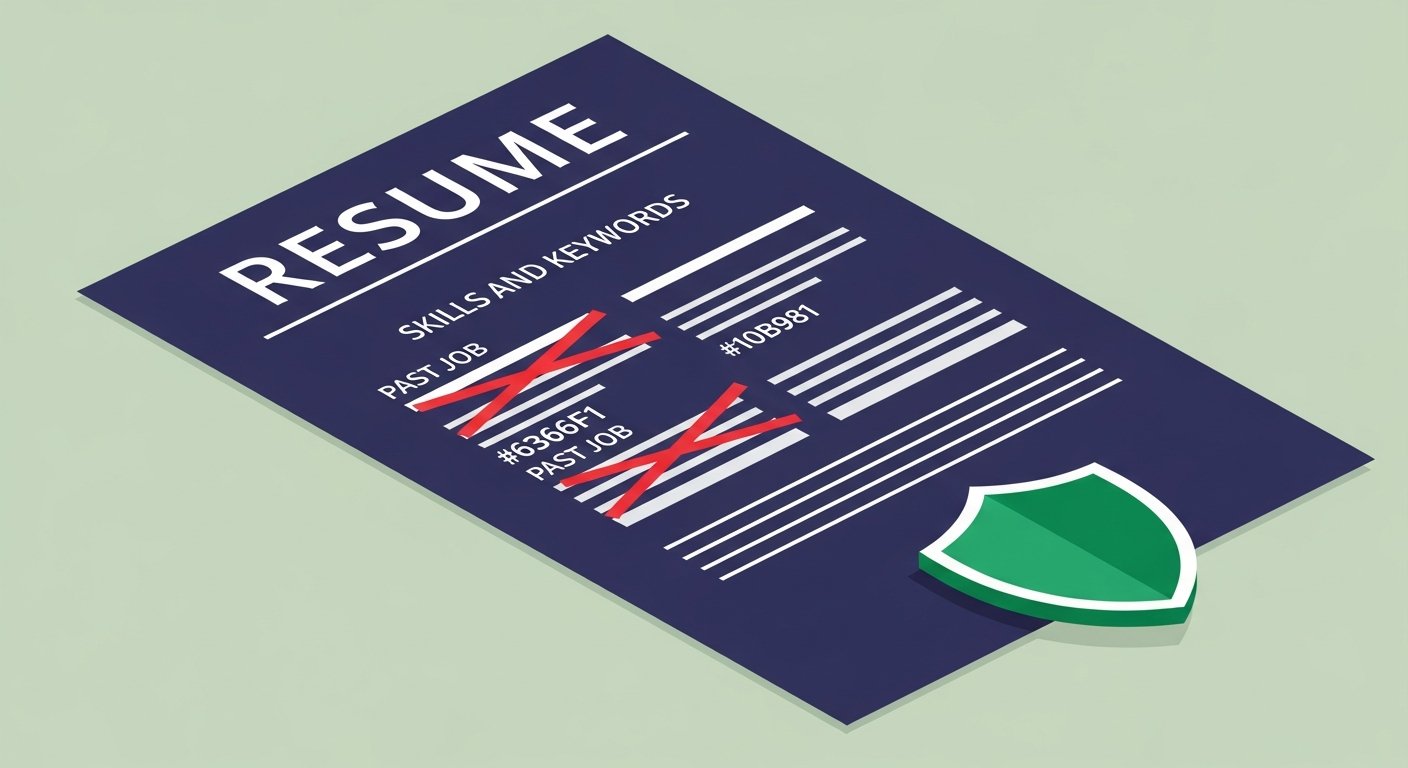
Cutting the right things from a resume is a relatively short list once you know what the algorithm actually weighs.
Safe to cut:
- Jobs from more than ten years ago, unless they contain keywords directly relevant to the role you're applying for
- "Proficient in Microsoft Word" — every ATS and every recruiter assumes basic computer literacy; it adds no score and no credibility
- Physical address — city and state is enough; no one needs your street number
- Soft-skill labels in your skills section: "detail-oriented," "team player," "results-driven" — every platform ignores them; prove soft skills in bullet points instead
- Awards and recognition that don't translate to a hard skill or a measurable outcome
- Relevant coursework, unless you're a recent graduate with limited work history
Do not cut:
- Keywords from the job description. Before removing any bullet, confirm it doesn't contain an exact-match phrase from the posting. If it does, find space elsewhere — not by cutting that bullet.
- Measurable outcomes. "Managed a team" is cuttable. "Managed a 6-person team that reduced customer churn by 22% in Q3" is not — it's evidence, and ATS platforms weight evidence-backed bullets above generic claims.
- Your skills section. Resumes with a dedicated skills section score an average of 10–15 points higher on ATS screening than equivalent resumes without one. It scores twice: once as a dedicated structured field, once in full-text search. Compress other sections first.
Before making any cuts, spend five minutes with the keywords your resume needs. Build the keyword list from the job description, map each one to its current location in your resume, and then cut from content that isn't carrying any keyword weight. This takes the guesswork out of what's safe to remove.
If you want to understand how much your skills section specifically contributes to your score, the breakdown in what skills to put on a resume covers placement, frequency, and format across different ATS platforms.

When a Single Page Resume Is the Wrong Move
Honestly, the one-page rule has always been a guideline for early-career candidates — not a universal standard. A 12-year career compressed onto one page loses the keywords, the context, and the proof. If you have the experience to fill two pages with relevant content, use them.
Seven or more years of experience. You have real things to show. A recruiter who sees 12 years of work history on one page knows you cut things. They don't know what you cut. Two pages signals "I have enough legitimate content to fill them." That's the right signal to send — especially since most ATS platforms don't penalise for two pages and reward for keyword density, which two pages gives you more room to demonstrate.
Technical roles where depth matters. A senior software engineer, data scientist, or cloud architect who compresses their project history to one page is cutting the specific technologies, environments, and contexts that ATS systems extract keyword data from. "Python" appearing once in a skills section scores differently than "Python" appearing in the skills section and in three work experience bullets describing specific projects. Keyword frequency and placement both affect score.
Executive and senior leadership candidates. Credibility at the leadership level comes from the arc — the progression, the scope changes, the scale of teams and budgets over time. A VP of Engineering who fits four senior roles onto one page looks like they're hiding experience or compressing years of context into soundbites. Two pages is standard at this level; three pages is acceptable for executive roles. The hiring process at that tier is different, and the one-page rule doesn't apply.
Any time your ATS score drops after shortening. This is the clearest rule: run your resume through an ATS checker before and after you make cuts. If the score drops, you removed something you needed. Put it back and find a different line to cut. A shorter resume with a lower ATS score is not a good trade.
If you've worked through all of this and you're still not sure whether your current resume is passing the filter, paste it into ATSFixer alongside the job description. You'll see your exact keyword match rate, which phrases you're hitting and which you're missing, and what's actually moving your score — which, unlike the one-page rule, is information specific to the job you're applying for.
You got to the end of an article about how many pages your resume should be. That's either impressive dedication or the clearest sign yet that the job search has been going on longer than you'd like. Either way: paste it in, check the score, then decide on the length.
Related from ATSFixer
Frequently Asked Questions
No. ATS platforms parse your resume as a stream of text and extract structured data — job titles, dates, skills, keywords. Page count is not a variable the algorithm measures. What affects your score is keyword density and placement: whether the exact phrases from the job description appear in your skills section, your work experience bullets, or both.

Jordan Marcus
Senior Career Strategist
Jordan has reviewed 4,000+ resumes and coached candidates into roles at Google, Stripe, and McKinsey. She writes about the mechanics of ATS and what actually gets people interviews.